Showing posts with label Brunswick Maine. Show all posts

Thursday, August 8, 2019

Smithsonian Project: "When Americans Feared an Invasion From Their Northern Border"


I was asked to write an article for a Smithsonian project called "What It Means to Be American," based on my book A Distinct Alien Race.

The article recounts “a lost chapter in U.S. immigration history that has startling relevance today—a story of immigrants crossing a land border into the U.S. and the fears they aroused."

"Inheriting an ideology of cultural survival from Québec, the French Canadians in the U.S. resisted assimilation. This led a segment of the American elite to regard these culturally isolated French speakers as a potential threat to the territorial integrity of the United States—pawns, conspiracy theorists said, in a Catholic plot to subvert the U.S. Northeast.”


Click here for the article.

Please share the link.
https://www.whatitmeanstobeamerican.org/encounters/when-americans-feared-an-invasion-from-their-northern-border/

Saturday, May 11, 2019

In Search of a Community’s First Franco-American School


I was travelling around New England – in a cold rain mostly – talking about my book A Distinct Alien Race. It was the final day of April 2019 and I woke up at 5:45 A.M. sharp and drove an hour to Brunswick, Maine to do an interview with WCME radio. I was through with the interview before 9 A.M. and found myself with a day to kill before a book signing at Brunswick’s Gulf of Maine Books at 7:00 P.M. But it’s easy to bide my time in Brunswick, since I always have research to do on the Franco-American community there.

Former Convent for St. John's School of Brunswick, Maine built in early 1890s. French-Canadian schools in New England.
Former Convent on Oak St. Brunswick, Maine
For years I’ve been curious about a Brunswick house, 12 Oak Street, once a small convent. On that same property was the first St. John’s School, the Franco-American parochial school my grandfather and his siblings attended. I have seen a fading photo or two of a clapboard building known locally as “the Little School,” located behind the brick convent. Per the U.S. Census, in 1900 my grandfather, then 6 years old, lived with his family at 24 Oak Street, just down the street from the school. That year, his two older brothers Geoffrey and Ludger attended the Little School.  

A 1927 book commemorating the 50th anniversary of Brunswick’s St. John’s parish asserts that the school was a project of Father J.-B. Sekenger, the community’s third pastor who arrived in town in September 1892. The priest’s first concern was to establish a proper parochial school and he contacted an order of nuns known as la Congrégation des Dames de Sion which had directed parish schools in Lewiston and Auburn, Maine. On September 11, 1894, eight nuns of this order arrived at the train station in Brunswick, taking up residence at the small brick convent. A hangar located in the back of the convent was transformed into a schoolroom. 

There had been talk of a "French school" as far back as 1883 ("French School," Brunswick Telegraph, June 29, 1883), and lay teachers were employed before the nuns' arrival. But the Little School was the town's first, dedicated parochial school, with resident nuns as teachers.  

The convent and the hangar-turned-schoolhouse still exist. During my recent visit to the town, I managed to find and photograph the former school, now dilapidated. The photos below show the school, with the pupils arranged in front of it, circa 1890-1900 (photo courtesy of the Pejepscot Historical Society) and then the building's current state.
St. John's School, Brunswick, Maine circa 1900. French-Canadian school in New England.

Original St. John's School of Brunswick, Maine in 2019

The 1927 commemorative book claims that the former Little School became a garage after the parish built a new school, in use by 1913. The former convent, says the 1927 book, became the residence of A. Tondreau, one of the most prosperous Franco-Americans of Brunswick.

Using publicly available county real estate records, now digitized and online, I was able to trace the history of the property at 12 Oak Street that contained the convent and the school, as well as the history of this street where my grandfather grew up.

The property that became Oak Street was once owned by Hon. Charles J. Gilman (1824-1901) and his wife Alice McKeen Dunlap Gilman, a granddaughter of Joseph McKeen the first President of Bowdoin College. Charles Gilman was a lawyer and politician. In the 1850s, he served in the Maine legislature and in the U.S. Congress. He was a delegate to the 1860 Republican convention that nominated Abraham Lincoln for President. It appears that the property owned by the Gilmans had come through Alice Gilman’s Dunlap family. 

An 1871 map of Brunswick shows that Oak Street did not yet exist. The map marks clearly the Gilman property. In 1889, Alice Gilman sold a large plot of land to Albert S. Rines of Portland, Maine. The red rectangle I placed on the 1871 map marks the property Rines purchased, as far as I can tell from its description in the deed.

Detail from 1871 Map of Brunswick
Red rectangle marks approximate range of Rines property
including future Oak St. 
Over the next several years, Rines sold bits of this property, lot by lot, much of it to Franco-Americans, who were expanding out of the company-owned tenements in this period. Those who could afford to buy property had started to occupy the northwest corner of downtown Brunswick, per an 1885 article in the local newspaper, the Brunswick Telegraph. The Rines lots were in this part of the town. Circa 1890, a new road, called Oak Street, was cut through property Rines had purchased from the Gilman family. By 1900, Oak Street was 100% Franco-American.

In 1890, a prominent Franco-American known as Alexis Sainte-Marie purchased one of the lots belonging to Rines on Oak Street. Per the 1880 U.S. Census, Sainte-Marie was a baker, apparently working on his own account, a rarity in a time when the bulk of the Franco-American workers toiled in the nearby Cabot textile mill. Sainte-Marie also operated a small boarding house in town, one of the few that the local paper writing in 1886 found to be in good shape, in a neighborhood that was in very poor condition at that time. Sadly, the Sainte-Marie family lost two children in the 1886 diphtheria outbreak caused by the poor conditions in the Franco-American neighborhood.

In 1893, Sainte-Marie sold the property on Oak Street to the Roman Catholic Bishop of Portland, under an 1887 Maine law known as the Corporation Sole. That law made all Catholic Church property in the state the sole possession of Maine’s ranking Bishop. Around the same time, a woman named Alphonsine Drapeau sold a property adjacent to Sainte-Marie’s to the Catholic bishop. I believe that these two properties, those sold by Sainte-Marie and Drapeau to the Church, are the property now demarcated as 12 Oak Street.

Real estate websites claim that the brick building at this address dates to 1889, but that is probably a year or two too early. Quite often, Maine's 19th c. deeds convey the "buildings thereon" when property is transferred, if there are buildings on the property in question. Since there are no buildings mentioned in the deed rendering the property from Rines to Sainte-Marie, I think it likely that Franco-American labor built both the brick convent and the wooden “hangar” that became the Little School. I believe that the brick convent was probably built for the purpose it first served, and was constructed right after Sainte-Marie purchased the property in 1890. It dates from the early 1890s, when another large brick structure in the town was built: the “new” Cabot Mill that still stands today as Fort Andross.

A local newspaper report of 1885 mentions that the Franco-Americans were building structures cooperatively in this part of the town. I surmise that Sainte-Marie bought this property on behalf of the Franco-American residents with the intention of building the convent and school there.  

After the nuns took possession of the convent, the Little School operated there for nearly 20 years. A 1901 map of Brunswick has the convent and school clearly labelled, ensconced at 12 Oak Street. The 1910 U.S. census lists the nuns who lived at 12 Oak Street and notes that nine of the eleven nuns residing there were teachers.

Detail from 1901 Map of Brunswick
Oak Street with convent and school indicated
When a new parochial school was built by 1913, Adjutor Tondreau purchased the property at 12 Oak Street from the Catholic Church. Tondreau, with his brother Omer, made a good living as proprietors of a local grocery store. They eventually purchased a block on Brunswick’s Maine Street that still bears their name. The block has a plaque commemorating the Tondreau brothers, born in Québec, who had made good in les États.
Tondreau Block, Maine Street, Brunswick
(Photo by Robby Virus)
With the 1913 sale, the former convent became a comfortable residence for a family, the former school serving as their garage. Per the historical plaque on the Tondreau Block, the brothers were famous for being among the first in the region to deliver groceries by truck, and I think it likely that, when not in use, the truck was parked in what had been the Little School.

The Tondreau family owned 12 Oak Street until 1995. The property, with the former convent divided into apartments, has had three owners since. Do the current owners or tenants know that the house was once the residence of pious nuns? Do they know that a generation or two of French-speaking students once filed into the school in their backyard, today a rundown outbuilding, resembling a barn, barely visible from Oak Street? There is no plaque or other recognition of the importance of these structures, most likely built by Franco-American hands. It was here, at this little school that my grandfather learned to read and write, and to speak English, since my grandfathers spoke French at home in Maine and learned their English in school.

To the town’s credit, there is some recognition there of the era of the Franco-Americans, who were quite visible and audible in Brunswick for about 100 years, from the mid-19th through the mid-20th century. There is a plaque near the pedestrian bridge that connects Brunswick with Topsham; there is the plaque on the Tondreau Block, and a photo in the former mill. But to the best of my knowledge and research, 12 Oak Street is one of the only remaining properties built by Franco-Americans to serve their community, when French was the language of this neighborhood – when it was the French Quarter where my grandparents lived and where my father was born.

Wednesday, April 6, 2016

Franco-Americans And Public Health In A Gilded Age

I have written and spoken much about the poor public health situation in the Franco-American community at Brunswick, Maine during the Gilded Age. I have speculated that such problems were by no means confined to Brunswick and that further research would bear out this conjecture.

The Second Annual Report of the State Board of Health of the State of Maine for the year 1886 provides further information on the public health situation in the state's Franco-American centers in this period. Doctor Onésime Paré of Brunswick, the only Franco-American physician cited in this lengthy report, provides the State Board of Health with precise details about the health crisis in his town that occurred in that year corroborated by other doctors who visited the town. The priest at Saint John's Church in Brunswick provided to the Board of Health the names of the Franco-American children who died of infectious diseases.

No, It Wasn't Just Brunswick 
The 1886 Annual Report finds similarly depressing details elsewhere. For example, Dr. C.W. Bailey of Westbrook reports: 
“The diarrhoeal diseases of children have been very prevalent. These cases have been principally among the French population, and insanitary (sic) conditions, with overcrowding of families, seemed to enter largely into the causation. Much is needed to improve the sanitary condition of this village. Some of the things that need to be remedied are insufficient drainage, bad arrangements of water closets and privies. We have a water supply drawn from the river directly above the village, and but a few miles farther up there are large manufactories where all the wastes and excreta are dropped into the river, and still farther up a large powder manufactory with all its accompaniments of acids, saltpetre, soda and soot. It seems to me that this must render the water unfit for cooking purposes.” (p 120)
It was overcrowding, along with pollution of the drinking water by sewage, that were also at the root of the two main killers in 1880s Brunswick: Diphtheria and Typhoid. The brief description of conditions among the “French population” in Westbrook is quite similar to the more extensive account of conditions in Brunswick’s “French Quarter” that Dr. Paré provides in this same report.

Elsewhere in this 1886 Report, Dr. S.J. Bassford of Biddeford states:

“Whooping cough has been quite prevalent and a number of deaths have resulted from it among the French children, but none, I think, among Americans.

For the improvement of our city I would suggest better drainage, closing certain wells and the introduction of water into tenements. We have a good water supply lately introduced and already much has been done towards improvement. Two cases of typhoid fever, I feel sure, were caused by drinking water taken from polluted wells. The water was analyzed, condemned, and the wells were closed.”
(pp 72f)

As in Brunswick, per Dr. Bassford’s report, we find some diseases confined to “the French children” with no apparent effect “among Americans.”

Doctor Frederick Bacon, also from Biddeford, reports: “The diarrheal diseases have been somewhat prevalent among the French children. I have thought that one cause of these diseases has been due to bad drainage.” (p 73)

Moving northward to Winthrop, a brief account by Dr. A.P. Snow observes:
“There has not been a great prevalence of the diarrhoeal diseases of children. Two deaths from this cause resulted in the French population, where there was a want of cleanliness about the premises. The general sanitary condition of this town is good.” (p 135)
Doctor Snow, then, makes a distinction between the conditions among "the French population" and the "general sanitary condition" in the rest of the town. The findings of Dr. Daniel Driscoll, also practicing in Winthrop, differ somewhat from Dr. Snow’s account: 
“The diarrhoeal diseases have been moderately prevalent, most of the cases having been among the Canadian population from eating unripe fruit and from bad sanitary surroundings.” (p 134)
I propose that the “want of cleanliness” and “bad sanitary surroundings” the good doctors note were due to the generally poor circumstances in which the Franco-Americans were housed. The “want of cleanliness” in Winthrop was most likely due to the same causes that we see in Brunswick: people housed in a situation in which it would be illegal to quarter an animal today.

The following observations by Dr. A.M. Foster, practicing medicine in the Franco-American town of Lewiston, illustrate the nature of the “want of cleanliness” among the "foreign population" caused by the inadequate infrastructures of 1886: 
“A vast number of the houses in this city are not connected with the city sewers and have the old filthy privies, in many instances complete nuisances. Sufficient care is not taken to properly dispose of the city garbage. It is dumped in close proximity to a quarter where a large part of the foreign population reside.” (p 98)
Moving the Farm to the City
From Waterville, another major Franco-American center in Maine, Dr. S.H. Holmes reports the following: 
“Cases of the diarrhoeal diseases of children have been frequent. There is quite a large French population, and with them the well is often within twenty feet of hog-pens and cow-stalls, thus assuring the pollution of the water. I think this the cause of a large prevalence of summer complaint.” (p 131)
According to a July 1886 story in the Brunswick Telegraph newspaper, the tenement houses in that town had no yards, and the houses were built “in close contact,” but somehow pigs, cows and other animals were kept in pens near the houses, with the sink spouts and privies also nearby.
Tenements in Brunswick,
late 19th or early 20th c, 

As in Brunswick, the "large French population" of Waterville kept farm animals near the wells. Recall that the French-Canadians who came to New England were from a rural milieu. I offer that what little wealth they carried with them into the industrial towns of New England was in the form of farm animals. Life in the tenements did not have enough room for both them and their livestock.

Conclusions 
Taken together, these findings suggest that Brunswick’s housing and public health issues in this era were not unique to that community. It appears that unsanitary and overcrowded conditions in the Franco-American housing were more the rule than the exception in the Maine mill towns of the Gilded Age.

Before our deniers and apologists swing into action, let’s own that non-Franco communities in Maine in 1886 had their share of health problems as well. Child mortality in those days tended to take a higher toll for all nationalities and classes than it does today – at least for those of us who live a First World lifestyle. And yet the calling out of poor conditions among the“French population” in the mill towns is consistent throughout the 1886 Report. I invite anyone to read the report and judge for themselves.

Further, it is evident that the 19th century doctors didn’t know the causes of some of the diseases they treat. It is crystal clear, however, that they knew well the hazards of the conditions in which the Franco-Americans were living. And they flag them as exceptionally bad even by 1886 standards. 

It appears that mill owners throughout the State employed a large army of laborers from Québec with no idea where to put them. Where the housing was mill owned and/or operated, the local managers of the mills weren’t too finicky about creating livable conditions for their employees, least of all for the children.

And the lack of housing and sanitary regulations in this period allowed them to get away with it for as long as they could. Thankfully, Boards of Health and caring physicians were on duty to record, at least, the malfeasance they saw in their communities. 

Thanks to James Myall for drawing my attention to the Annual Report discussed in this post. The page numbers cited above refer to this report.

Monday, August 31, 2015

The Children's Strike In A Gilded Age Mill

“A little child shall lead them,” the Bible says. And so it was in Brunswick, Maine in 1881 when young boys not only participated in a strike at the Cabot textile mill – they caused the strike.

This curious tale is reported in the August 12, 1881 edition of the local newspaper, The Brunswick Telegraph (beginning on page 2). According to this report, drawn together from local sleuthing as well as from other newspaper accounts, a strike broke out among “the operatives in the spinning and mule rooms of the Cabot Company’s cotton mill…These strikes left the weavers short of working material and the mill was shut down.”

In response to the strikes that occurred on a Thursday in early August and again the following Monday, the Telegraph reports that the mill was closed apparently for the better part of a week, although the Telegraph’s account leaves the chronology uncertain.

The observation that young boys started the strike at the mill, extraordinary by modern lights, is tossed off at the end of the article in a single sentence. The strike began when “boys 8 to 14 years of age struck for higher pay, got it, and thus led to strikes in [the] spinning and mule rooms.” It was the success of the children’s strike that led the adults to hope for similar results.

The fact that it was the boys’ example that led the adult workers to strike is attributed to a report in the Bath Times “prepared by a reporter after careful enquiry.” However, “the operatives do not appear to have had any concerted action and moved apparently without leadership,” the Telegraph reports.
1894 Death Certificate of Adelard Duford
"Age: 11" "Occupation: Mill Operative"
Thanks Janine LaFleur Penfield

A.G. Tenney, the editor of the Telegraph and most likely the writer of the article in question, suggests a motive for the boys’ strike: “It is stated that the wages in the mill have been rather under than above the average of the cotton mills of this State, – that some of the young children work at $1.00 per week, and some as low as 8 cents per day, but this latter statement we are unwilling to accept.” Tenney gives no reason for his incredulity regarding the wages paid, although he attributes these figures to “outside talk.”

Tenney also reports that the workers demanded a ten percent raise, which they seem to have believed would put their pay in line with the wages at comparable mills in nearby Lewiston and Lisbon.

Don’t Call It a Company Store!
The Telegraph mentions that the grocery store “commonly known as the factory store” closed for at least one day in response to the strike. The proprietors of the mill, says Tenney, "denied all connection” to the store operated by “Messrs. Adams Bros.” The closure of the store in concert with the mill lock-out raised suspicions regarding this denial, notes Tenney.

The workers apparently had no doubt about the connection between the store and the Company since, reports the Telegraph, “some wicked wag…suspended [on the store] a red flag inscribed ‘Store closed,’ ‘Small pox.’”

The Telegraph also mentions “the payment of help through the system of orders” to the Adams’s grocery store, a system which, Tenney reports, many observers opposed. He attributes to the system's opponents “the general belief...that cash should be paid and the purchases made by the workman wherever he chooses to trade.” This “system of orders,” well-known enough to invite comment in the town, refutes the Cabot Company's denial of “all connection” between the store and the mill.

Another effect of the strike was that Benjamin Greene, the local agent of the mill, the face of the Cabot Manufacturing Company in the town, and the richest man in Brunswick, gave 30 day's notice to vacate to the residents in the company-owned tenements. Tenney justifies Greene’s action, stating that the notice to the tenants may have been “done as a measure of precaution if the strike holds on.”

As a rule, the mill workers in Brunswick in this period were housed in company-owned tenements. They were, to quote an 1885 New York Times piece about New England’s French-Canadians elsewhere in the region, “the despair of sanitarians.” This was due not to our ancestors’ slovenliness but rather to the failure of the likes of the Cabot Company to build an adequate infrastructure to house a population measured in four figures.

In fact, just a month before this strike, the Telegraph, generally a friend to neither Mr. Greene nor the Cabot Company, had featured a lengthy piece about a Typhoid outbreak in these self-same tenements which was blamed on the Cabots' malfeasance. 

“French” = “Mill Worker”
The piece also makes clear that to be “French,” that is to say to be one of the French-Canadian immigrants in the town, is to be a mill worker in 1880s Brunswick. The paper reports that as early as the Wednesday following the Monday lock-out “several French families had left” implying that they did so in response to the strike. Tenney then states that on further investigation this report was shown to be untrue, but he notes that “some [French families] contemplate leaving.”

He also reports that, “no disturbance has occurred, the French people walking about the village, and lots going blue-berrying.” That was not an unwise move given the situation with the company grocery store.

The circumstances of the Franco-American workers in Brunswick in this period are by no means uncommon in the history of 19th c. Labor. Here we find an imported, foreign labor force housed by the same company that employs them, that then pays them, at least in part, not in cash but in orders from the company store.

The system of keeping the workers in a state of dependency appears to have faced some opposition within the town since it inhibited a potential market for local housing and retail trade. This was no small loss to the local economy since per the 1880 U.S. Census the Franco-American population of Brunswick comprised more than one-fifth of the town's headcount. But the Franco-American workers were in a closed circuit where the Cabot Company was their all.

It is not surprising that the French-speaking workers had recourse to the only tool at their disposal – the strike – but that they did not use it more often. Of course, strikes in that era came at great personal risk. Especially when the thirty-day eviction notice arrives at the worker's apartment as soon as the strike begins.

And in August of 1881, this risk was run because some eight-year-olds found out that the eight-year-olds over in Lewiston were pulling in perhaps a penny more than their measly dime a day.

For more on Franco-Americans in the textile industry please see my new book available here.

Monday, December 29, 2014

Video Presentation: The Cabot Mill and Brunswick, Maine's Franco-Americans

This is a video of a presentation I delivered in April 2014 through the auspices of the Pejepscot Historical Society of Brunswick, Maine. It details the development of the Franco-American community in that town and the history of the textile mill that began to bring French-Canadians to Brunswick in the mid 19th century.

Among other topics I discuss:
  • Reasons for the exodus from rural Québec
  • Chain migration from L'Islet, QC to Brunswick
  • Conditions in the company-owned housing
  • The background of the Boston Brahmin mill owners
  • The steps the Franco-Americans took to improve their lot in adverse conditions
This talk covers some of the research I have written about before (for example here and here) but includes research and graphics that I have never before published.

I hope you have time to sit back and enjoy this presentation.


Wednesday, December 12, 2012

(Another) Canadien in the American Civil War: Cyprien Racine Becomes George Root

In an earlier post I told the story of Philibert Racine alias Philip F. Root. Philibert was a Canadien veteran of the Civil War and the brother of two of my great-great-grandmothers. He served with the First Vermont Battery Light Artillery that saw action in the Red River campaign in Louisiana.

I mentioned in that post that Philibert reportedly had a brother who called himself George S. Root who served in this same unit in the Civil War. I surmised that “George” was an alias for Cyprien Racine, baptized May 30, 1843 at Saint-Damase-de-Saint-Hyacinthe, Québec. I believe that I can now confirm the theory that George S. Root was Cyprien.

In the records of the U.S. National Archives I find the following pension document recording the February 25, 1928 death of a George S. Root.

The record appears to indicate that George S. Root’s rank was Artificer, that he served in the 1st (Independent) Battery Vermont Light Artillery, and gives his place of death as Mendon, Michigan.

The place of death was significant since I had information from Racine genealogist extraordinaire, Jules Racine of Québec, that another brother of Philibert, Charles Appolinaire Racine, had contracted his second marriage in Mendon, St. Joseph County, Michigan.

I turned to the 1920 U.S. Federal Census, eight years prior to the veteran’s death, and found a George S. Root living with his wife Lucy in Mendon Township, MI. The census reports that George was born in Canada, his mother tongue was French, and that the same is true of both of his parents.

The census gives his age as 75 on January 9 or 10th of 1920, which, assuming he hadn’t yet had his birthday that year, yields a birth year of 1844. Tracing George and Lucy back through the U.S. Census of Mendon, MI, I find that George, a farmer by trade, in 1900 gives his month and year of birth as May 1844.

This is reasonably close to the May 1843 date of birth of Cyprien Racine, given that these discrepancies are often found in the census records. The information in the census seems fairly consistent with my theory that George and Cyprien are the same person.  

In 1880 I find George, Lucy and family in nearby Leonidas, MI. Here we learn that the couple had three daughters Mary, 9, Catherine, 7, and Virginia, 2. The two older girls were born in Kansas, while the youngest was born in Michigan. This places George and Lucy in Kansas from about 1871 to about 1873 but likely back in Michigan by 1878 or so.

Searching for the marriage record of George and Lucy, I find a wedding at Mendon, MI on May 27, 1869 of a George Root, born in Canada, to a Lucia Monton (also Mouton or Moutaw) born in Mendon. The age of the groom is recorded as 24, which is consistent with a birth year of 1844 or 1845.

The final document in this series is an application to the U.S. War Department for a veteran’s headstone made by Mrs. Virginia Lighthiser, most likely George S. Root’s daughter whom we met as a two-year-old in the 1880 census.

This record confirms that a George S. Root, who had close kin named Virginia, served in the Civil War in the First Vermont Battery Light Artillery, died on February 25, 1928, and is buried in Mendon, MI.

I have little doubt that my theory is correct that George S. Root is Cyprien Racine. I can now piece together the outline of his life.

Born in Québec in 1843, his family lived briefly in Richford, Vermont, on the Québec border, in the late 1840s and early 1850s before they eventually settled in Roxton Falls, QC. By 1861, Cyprien, says the Canadian census of Roxton Falls in that year, is back in the United States.

In January 1862, at the age of 18, he enlisted for service in the American Civil War and served until August 1864. He appears to have returned to Canada but, by 1869, he is married in Michigan to a woman from that state.

The family spends the earlier portion of the 1870s in Kansas before returning to St. Joseph County, Michigan. George’s is a farm family and he lives for most of his days in his wife’s hometown where he dies, at age 84, and is buried.

His brother Philibert lived in a Franco-American enclave in Brunswick, Maine, but George did not live among other Canadiens. Philibert used his Yankee alias, Philip F. Root, when it suited him and reverted to his ancestral Racine identity when that served him better.

His tombstone in St. John’s Catholic Cemetery in Brunswick reads “Philibert Racine” while the document above indicates that Cyprien's government issue headstone reads "George S. Root."

I see no evidence that Cyprien ever used his French name after coming to the States. The census says that he was a naturalized U.S. citizen and he was so not only by law, but also de facto.

Cyprien Racine, the son of a man who fought for the liberté of Québec in the Rebellion of 1837, became Grand Army of the Republic veteran and Midwestern farmer George S. Root.

Monday, November 26, 2012

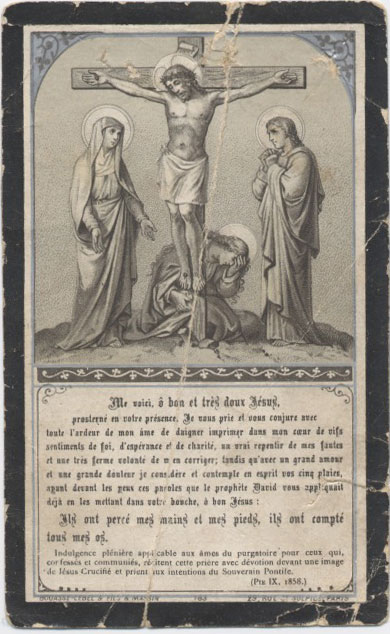
Cartes mortuaires: Funeral Cards of My Grandmother's Relatives

My grandmother showed me these funeral cards when I was a young boy. They seemed to come from another world, a context that had long-since faded away. They are a remnant of the Maine Franco-American culture as it existed in the early 20th century.

I am sure that many of my fellow Franco-Americans will nod in sympathy and familiarity with these cards, which they may have piled in a box or stuffed in a bottom drawer. 

For me these cartes mortuaires are precious relics. I can remember the reverence with which my grandmother revealed them to me, as if whispering a secret. Seeing them when I was young provided a small spark of inspiration leading me to take an interest in our family's past.

These cards represent my grandmother's maternal relatives all of whom came from what was then called the County of L'Islet, QC, the parish of Saint-Cyrille (also known as Saint-Cyrille-de-Lessard). The handwritten inscriptions on the cards are my Mémère's. She made these inscriptions in English so that her posterity would not forget her forbears.

I offer them without further comment, a moment of silence for our dearly departed.


I. Louis Bernier: uncle and godfather of Ida Lavigueur (Vermette)


II. Clarina Couchon: aunt and godmother of Ida Lavigueur

III. Arthur Bernier: grandfather of Ida Lavigueur

IV. Marie Saint-Pierre: grandmother of Ida Lavigueur

In October 2005 I visited Saint-Cyrille-de-Lessard for the first time and took the following photos. I'm not sure that any of the descendants of our line of the Berniers had returned to their ancestral parish since the times of our ancestors whose lives are commemorated above.

Here is a portion of the small parish of Saint-Cyrille seen from the hill on which sits the Church.
 

Aiming the camera just to left of the photo above, this picture shows a little of the Saint-Cyrille landscape.


Saturday, November 3, 2012

Memory, Culture, and Franco-American Identity

Last month I invited Michigan native James LaForest to be a guest poster on this blog. James has now returned the favor and invited me to contribute to his. Please read my post Memory, Culture, and Franco-American Identity on James’s fine cultural and literary blog Red Cedar (formerly called Daily Returns).

After reading my post, please stick around to peruse James’s thoughtful reflections. He is a sensitive writer with a gentle touch. We’re pleased with our collaboration and hope readers of both blogs will enjoy it as well.


The Cabot Mill Complex, Brunswick, Maine, 1908

Thursday, September 20, 2012

Naturalization and Leadership in the Franco-American Community at Brunswick, Maine

General histories of the Franco-American communities in New England have claimed that the immigrants resisted naturalization. The usual reasons cited include a desire to avoid paying taxes to two governments and to evade service in the American military. The Franco-American community at Brunswick, Maine, however, does not seem to have been troubled by such concerns. Consider this item from the August 22, 1884 edition of the local newspaper, the Brunswick Telegraph, page 3:
Meeting of the French-Canadians. A meeting of French-Canadians was held in the Court Room, Town Hall, Monday evening, Joseph Dufresne being elected temporary chairman, and Louis Trudeau, sect'y. Henry Ragot addressed the meeting in French, upon topics in which the people were interested, the result of which was the formation of a permanent organization. President, Noel Vandall; Secretary, Louis Trudeau; Vice Presidents, Exavier Payment, Ermenigle Coulombe, Telesphore LaPoint, Jos. Machaud, Frank Maturin, Jos. Dionne, and Henry Ragot, Marshall.

The subject of naturalization was discussed, the question being, shall the French take out naturalization papers or remain foreigners? It was unanimously decided to naturalize, and 53 were found to be ready for naturalization; others will be naturalized when they become eligible. It was also decided that all possible means of information should be resorted to, to gain political information. (Note: Names spelled as they appear in the original article.)

The article shows the communal, tight-knit character of the Franco-American group in Brunswick. Although some Brunswick Franco-Americans had attained U.S. citizenship prior to the meeting, the issue of naturalization was not decided on an individual basis. It was deemed a vital interest of the Franco-American community as a whole and the community met in a body to discuss it. A consensus was reached and a "permanent organization" formed.

Who were the leaders mentioned in the article? Since many of the Brunswick Franco-Americans were from the village and county of L'Islet on the south bank of the Saint Lawrence does it then follow that the majority of the leaders were from this location? Were these leaders already naturalized and therefore able to help others to achieve citizenship?

I researched these leaders using Naturalization Petitions and checked the information there against the Drouin Institute microfilm of the Québec parish registers. Where there is a discrepancy between the date of birth given on the naturalization petition and what I discovered in the parish registers I have placed the date found in the latter in parentheses with the parish name and the number of the baptismal record.
  • Noel Vandal, President: b. Sorel, 1845 (December 25, 1844, Saint-Pierre-de-Sorel, B. 323). Arrived in USA: April 1, 1860. His initial "port of arrival" in the USA was the state of Rhode Island. The 1880 census corroborates that Noel and his wife had at least one child born in the Union's smallest state. He was naturalized on April 4, 1876. No witnesses are listed with his naturalization petition.
  • Louis Trudeau, Secretary: b. Saint-Constant, County of Laprairie, October 1, 1849. Arrived in USA: November 16, 1866, Brunswick. Naturalized: September 10, 1886. Witnesses: Alexis St-Marie, Casimir Deshetre, and Henri Ragot of Brunswick. 
  • François-Xavier Paiement ("Exavier Payment"), Vice President, b. Roxton Falls, Shefford County, June 6, 1857. Arrived in USA: March 1, 1869, Brunswick. Naturalized: August 23, 1882. Witnesses: L. (Louis) Normand and P.F. Root (Philibert Racine, alias Philip F. Root). 
  • Herminigilde Coulombe ("Ermenigle Coulombe"), Vice President, b. L'Islet, September 4, 1858 (September 4, 1857, Notre-Dame-de-Bonsecours (L'Islet), B. 143). Arrived in USA: June 15, 1871, provides no place of entry. Naturalized: August 28, 1880. Witnesses: Joseph Dionne and Thomas Gagné of Brunswick.
  • Telesphore Lapointe ("Lapoint"), Vice President, b. Kamouraska, March 25, 1857 (March 26, 1858, Saint-Louis-de-Kamouraska, B. 30). Arrived in USA: March 1, 1871, Brunswick. Naturalized: September 11, 1886. Witnesses: Philip F. Root and Andrew Libby (André L’Abbé).
  • Joseph Michaud ("Machaud"), Vice President, gave his place of birth as "Quebec." This could mean either a parish somewhere in the province or perhaps he means the city of Québec. Date of birth: November 19, 1851. Arrived in USA: April 16, 1869, Brunswick. Naturalized: August 28, 1880. Witnesses: Joseph Dionne and Andrew Libby.
  • François-Xavier Mathurin ("Frank Maturin"), Vice President, b. Sainte-Rosalie, Bagot County, December 27, 1864 (December 26, 1863, Sainte-Rosalie-de-Bagot, B. 55). Arrived in USA: July 10, 1868, Brunswick. Naturalized: September 5, 1888. Witnesses: Pierre Letarte and Joseph Dionne.
  • Joseph Dionne, Vice President, b. Saint-Alexandre, County of Kamouraska, July 14, 1862. Arrived in USA: 1870, Brunswick. Naturalized: March 1, 1884. In his naturalization petition, filed just a few months prior to the publication of the article transcribed above, Joseph gives his address as Lewiston, not Brunswick. His witnesses, P.X. Angus and John McGraw are Lewistonians. I’m persuaded that this is probably the man cited in the article above, but I can’t be sure. There was no shortage of Joseph Dionnes available in Québec and its New England extensions at this time. 
Although his name appears in at least two petitions as a witness, I have not been able to find a petition for Henri ("Henry") Ragot, the only leader who is mentioned as having addressed the 1884 meeting. Unlike almost all of the Brunswick Franco-Americans of the time, the census of 1880 indicates that Henri Ragot, born in 1850, did not work for the Cabot textile mill. He was employed as a glassmaker. Louis Trudeau, not surprisingly, given his role as Secretary was a clerk. He was not an operative in the mill although he may have clerked at the mill.

Although the naturalization petitions do not allow us to determine the last known Québec residence of our petitioners (which is not necessarily the same as their place of birth), it appears that the L'Islet Brunswickers were not especially prominent in the leadership group. The leaders of the "permanent organization" had their origins in many regions of Québec. I find only one representative from L'Islet among them.
Naturalization Petition for Theodore Vermette. French-Canadian born person naturalized in New York.
Naturalization Petition for Theodore Vermette:
He must swear he is neither an anarchist nor a polygamist!

Five of the eight leaders identified above were United States citizens at the time of the 1884 meeting. Allowing for some inaccuracies with respect to the very precise dates the petitioners provide for their arrival in the States it is evident that the leaders had been acquainted with Brunswick for some time. Most of them arrived in the 1860s and all of them claim to have come to the States before 1872.

Among the leaders, the President, Noel Vandal, had been in the States the longest. He was south of the border nearly 25 years before the 1884 meeting. He was naturalized eight years prior his election as President.

The Brunswick Franco community at large decided that it was to its advantage to engage the American political process. This makes Brunswick an exception to what we read in some general histories and contradicts the messages about Franco-Americans in the mainstream media of the day.

Monday, August 13, 2012

Of How Many Does a French Canadian Family Consist?

The following item appeared in the Brunswick (Maine) Telegraph, May 28, 1875, page two.

Of how many does a French Canadian Family Consist?
A few facts will furnish a reply. There is a family at work in the cotton mill, which consists of a father and mother and twenty-four children, all the children large enough being at work. The woman is the fourth wife; a brother of the husband living with his fifth wife in Montreal, has twenty-five children. Three families arrived here last week to go to work in the mill and they numbered all told 37 persons. A lady friend of ours a few days since met a Frenchwoman, who, looking at the babe in the carriage said to our friend, “I have got fifteen of those.” The only possible reply of the lady with the one babe was, “Oh Lordie!” Ten and twelve and fifteen children are by no means uncommon in the French Canadian families, but twenty-four are a little above average.
My great-grandfather was one of 23 children by two wives. Another great-grandfather was one of 17, all born to the same woman. As astonishing at this seems by modern standards we might bear in mind that family size is conventional. There is no normal family size and customs vary.

The Ouellettes And Their Twelve Children
The picture on the right shows my great-great-grandparents Thomas Ouellette and Josephine (Racine), seated in the center, with their adult children in 1909. These are not their children accompanied by their spouses. All of these people are their children. One of the children, Thomas Ouellette fils, is not in the picture since this photo was taken in Maine and he had returned to live in his native Québec by this point. Another child seems to have died before this photo was taken. I can confirm that Josephine bore at least 14 children and there may have been others about whom I don’t yet know. (My great-grandmother Albina Ouellette Vermette, b. Roxton Falls, QC, 1868 is seated at the far right.)

I am often asked why they had such large families. The usual assumption is that the children were required to serve as the labor force on the family farm. This may have been one reason for the custom of large families, particularly in the earlier days when land needed to be cleared and more hands meant more axes chopping down more trees.

Another reason for the large families was political and involved what was known as la revanche des berceaux – the revenge of the cradles. The idea was that the Francophones would retake Canada from their English conquerors by out-reproducing them. I’ve heard some stories of priests in the confessional asking fathers (mothers seem to have had little say in the matter) why they were not producing more children.

The revenge of the cradle backfired. The rapid population growth outstripped the economic/agricultural development required to support it. This strategy, intended to bring about demographic dominance, led to the departure of a large percentage of the population. Historians will continue to debate the point but it seems to me that the flight from Québec in the later 19th and early 20th centuries, both to the States and to other Canadian Provinces, was the result of an underdeveloped economy.

Given the economic and personal risk, the emotional toll, as well as the social sanctions against making such a move, it seems unlikely that the rural poor would have left la belle province in such numbers unless they were under duress. Many families auctioned off all they had to finance their trip to the States. That’s a risky, desperation move.

Another reason for large families is that children were a farmer’s retirement plan, his and his wife’s Social Security. Life expectancy was considered to be about 65 years for those who survived childhood. In order to enjoy a few years of retirement after a long life of hard work on the farm, it was necessary to produce a son who could inherit the property and support the habitant and his wife in their old age. This son would need to be grown, established, and able to take over his father’s farm by the time his parents reached about 55 to 60 years of age.

About a third of the children born alive did not make it to adulthood. If a couple’s first children were girls, they had to keep reproducing in order to have a son ready to inherit at a suitable age. Since there was a one-in-three chance that any son produced would die in childhood, the couple’s insurance policy, at least up until a certain point in life, was to keep reproducing as long as they were able.

These practical reasons were probably not uppermost in the minds of the parents of these families, however. Once the custom of large families was established it persisted by the inertia characteristic of traditional societies. It was accepted and normal in their world that a woman would be pregnant most of the time between ages 20 and 40. 

Although large families continued to be a custom in the Québec Diaspora in New England, the birth rate began to drop slowly when these families moved into an industrial economy. In these New England Franco-American families, the “revenge of the cradle” factor and the motive related to the traditional socio-agricultural system lost their relevance. The Franco-Americans may have been influenced also by the relatively smaller family sizes of their Yankee neighbors. That said, large families persisted in many Franco-American communities well into the 20th century. The birth rate in Québec did not decline until about 1960.