Showing posts with label Catholic Church. Show all posts

Saturday, May 11, 2019

In Search of a Community’s First Franco-American School


I was travelling around New England – in a cold rain mostly – talking about my book A Distinct Alien Race. It was the final day of April 2019 and I woke up at 5:45 A.M. sharp and drove an hour to Brunswick, Maine to do an interview with WCME radio. I was through with the interview before 9 A.M. and found myself with a day to kill before a book signing at Brunswick’s Gulf of Maine Books at 7:00 P.M. But it’s easy to bide my time in Brunswick, since I always have research to do on the Franco-American community there.

Former Convent for St. John's School of Brunswick, Maine built in early 1890s. French-Canadian schools in New England.
Former Convent on Oak St. Brunswick, Maine
For years I’ve been curious about a Brunswick house, 12 Oak Street, once a small convent. On that same property was the first St. John’s School, the Franco-American parochial school my grandfather and his siblings attended. I have seen a fading photo or two of a clapboard building known locally as “the Little School,” located behind the brick convent. Per the U.S. Census, in 1900 my grandfather, then 6 years old, lived with his family at 24 Oak Street, just down the street from the school. That year, his two older brothers Geoffrey and Ludger attended the Little School.  

A 1927 book commemorating the 50th anniversary of Brunswick’s St. John’s parish asserts that the school was a project of Father J.-B. Sekenger, the community’s third pastor who arrived in town in September 1892. The priest’s first concern was to establish a proper parochial school and he contacted an order of nuns known as la Congrégation des Dames de Sion which had directed parish schools in Lewiston and Auburn, Maine. On September 11, 1894, eight nuns of this order arrived at the train station in Brunswick, taking up residence at the small brick convent. A hangar located in the back of the convent was transformed into a schoolroom. 

There had been talk of a "French school" as far back as 1883 ("French School," Brunswick Telegraph, June 29, 1883), and lay teachers were employed before the nuns' arrival. But the Little School was the town's first, dedicated parochial school, with resident nuns as teachers.  

The convent and the hangar-turned-schoolhouse still exist. During my recent visit to the town, I managed to find and photograph the former school, now dilapidated. The photos below show the school, with the pupils arranged in front of it, circa 1890-1900 (photo courtesy of the Pejepscot Historical Society) and then the building's current state.
St. John's School, Brunswick, Maine circa 1900. French-Canadian school in New England.

Original St. John's School of Brunswick, Maine in 2019

The 1927 commemorative book claims that the former Little School became a garage after the parish built a new school, in use by 1913. The former convent, says the 1927 book, became the residence of A. Tondreau, one of the most prosperous Franco-Americans of Brunswick.

Using publicly available county real estate records, now digitized and online, I was able to trace the history of the property at 12 Oak Street that contained the convent and the school, as well as the history of this street where my grandfather grew up.

The property that became Oak Street was once owned by Hon. Charles J. Gilman (1824-1901) and his wife Alice McKeen Dunlap Gilman, a granddaughter of Joseph McKeen the first President of Bowdoin College. Charles Gilman was a lawyer and politician. In the 1850s, he served in the Maine legislature and in the U.S. Congress. He was a delegate to the 1860 Republican convention that nominated Abraham Lincoln for President. It appears that the property owned by the Gilmans had come through Alice Gilman’s Dunlap family. 

An 1871 map of Brunswick shows that Oak Street did not yet exist. The map marks clearly the Gilman property. In 1889, Alice Gilman sold a large plot of land to Albert S. Rines of Portland, Maine. The red rectangle I placed on the 1871 map marks the property Rines purchased, as far as I can tell from its description in the deed.

Detail from 1871 Map of Brunswick
Red rectangle marks approximate range of Rines property
including future Oak St. 
Over the next several years, Rines sold bits of this property, lot by lot, much of it to Franco-Americans, who were expanding out of the company-owned tenements in this period. Those who could afford to buy property had started to occupy the northwest corner of downtown Brunswick, per an 1885 article in the local newspaper, the Brunswick Telegraph. The Rines lots were in this part of the town. Circa 1890, a new road, called Oak Street, was cut through property Rines had purchased from the Gilman family. By 1900, Oak Street was 100% Franco-American.

In 1890, a prominent Franco-American known as Alexis Sainte-Marie purchased one of the lots belonging to Rines on Oak Street. Per the 1880 U.S. Census, Sainte-Marie was a baker, apparently working on his own account, a rarity in a time when the bulk of the Franco-American workers toiled in the nearby Cabot textile mill. Sainte-Marie also operated a small boarding house in town, one of the few that the local paper writing in 1886 found to be in good shape, in a neighborhood that was in very poor condition at that time. Sadly, the Sainte-Marie family lost two children in the 1886 diphtheria outbreak caused by the poor conditions in the Franco-American neighborhood.

In 1893, Sainte-Marie sold the property on Oak Street to the Roman Catholic Bishop of Portland, under an 1887 Maine law known as the Corporation Sole. That law made all Catholic Church property in the state the sole possession of Maine’s ranking Bishop. Around the same time, a woman named Alphonsine Drapeau sold a property adjacent to Sainte-Marie’s to the Catholic bishop. I believe that these two properties, those sold by Sainte-Marie and Drapeau to the Church, are the property now demarcated as 12 Oak Street.

Real estate websites claim that the brick building at this address dates to 1889, but that is probably a year or two too early. Quite often, Maine's 19th c. deeds convey the "buildings thereon" when property is transferred, if there are buildings on the property in question. Since there are no buildings mentioned in the deed rendering the property from Rines to Sainte-Marie, I think it likely that Franco-American labor built both the brick convent and the wooden “hangar” that became the Little School. I believe that the brick convent was probably built for the purpose it first served, and was constructed right after Sainte-Marie purchased the property in 1890. It dates from the early 1890s, when another large brick structure in the town was built: the “new” Cabot Mill that still stands today as Fort Andross.

A local newspaper report of 1885 mentions that the Franco-Americans were building structures cooperatively in this part of the town. I surmise that Sainte-Marie bought this property on behalf of the Franco-American residents with the intention of building the convent and school there.  

After the nuns took possession of the convent, the Little School operated there for nearly 20 years. A 1901 map of Brunswick has the convent and school clearly labelled, ensconced at 12 Oak Street. The 1910 U.S. census lists the nuns who lived at 12 Oak Street and notes that nine of the eleven nuns residing there were teachers.

Detail from 1901 Map of Brunswick
Oak Street with convent and school indicated
When a new parochial school was built by 1913, Adjutor Tondreau purchased the property at 12 Oak Street from the Catholic Church. Tondreau, with his brother Omer, made a good living as proprietors of a local grocery store. They eventually purchased a block on Brunswick’s Maine Street that still bears their name. The block has a plaque commemorating the Tondreau brothers, born in Québec, who had made good in les États.
Tondreau Block, Maine Street, Brunswick
(Photo by Robby Virus)
With the 1913 sale, the former convent became a comfortable residence for a family, the former school serving as their garage. Per the historical plaque on the Tondreau Block, the brothers were famous for being among the first in the region to deliver groceries by truck, and I think it likely that, when not in use, the truck was parked in what had been the Little School.

The Tondreau family owned 12 Oak Street until 1995. The property, with the former convent divided into apartments, has had three owners since. Do the current owners or tenants know that the house was once the residence of pious nuns? Do they know that a generation or two of French-speaking students once filed into the school in their backyard, today a rundown outbuilding, resembling a barn, barely visible from Oak Street? There is no plaque or other recognition of the importance of these structures, most likely built by Franco-American hands. It was here, at this little school that my grandfather learned to read and write, and to speak English, since my grandfathers spoke French at home in Maine and learned their English in school.

To the town’s credit, there is some recognition there of the era of the Franco-Americans, who were quite visible and audible in Brunswick for about 100 years, from the mid-19th through the mid-20th century. There is a plaque near the pedestrian bridge that connects Brunswick with Topsham; there is the plaque on the Tondreau Block, and a photo in the former mill. But to the best of my knowledge and research, 12 Oak Street is one of the only remaining properties built by Franco-Americans to serve their community, when French was the language of this neighborhood – when it was the French Quarter where my grandparents lived and where my father was born.

Monday, April 8, 2013

2012 Study of Maine Franco-Americans Sheds Light On The Names We Call Ourselves

The descendants of Nouvelle-France have been known by many names. In a recent post I discussed in particular the significance of the various appellations applied to the descendants of the former French colony of Canada: Canadien, Canadien-français, and Québécois.

A new study of Maine's Franco-Americans sheds light on these labels and the other names we call ourselves.

The study was conducted by polling firm Command Research and commissioned by the Centre Franco-Américain at the University of Maine at Orono under the auspices of the Maine state legislature's Franco-American Task Force.

Administered in July and August of 2012, the phone-based survey included 600 respondents who self-identify as Franco-American. An initial analysis of the data appears in the paper Contemporary Attitudes of Maine’s Franco-Americans, co-authored by Jacob Albert, Tony Brinkley, Yvon Labbé and Christian Potholm.

Respondents were asked, “Into which subgroup of the Franco-American background or heritage would you put yourself?”  The question yielded the following percentages of respondents:

Acadian
7.5%
Québécois
10.0%
French Canadian/Canadian/Franco
50.5%
Other (metropole French, etc.)
0.1%
Combination
8.8%
Don’t Know
23.0%
 
About one-half of respondents identified with the English equivalents of the designations Canadien, Canadien-français, or Franco-Américain. Nearly one quarter did not know. This leaves slightly more than one-quarter divided among the three responses, “Acadian,” “Québécois,” or some combination of labels.

The researchers found that the Québécois subgroup, 60 of the 600 respondents, differed from the others in a number of ways. 
  • 80% of the self-identified Québécois subgroup claimed that speaking the French language was “very important” to their “sense of being a Franco-American” compared with about 40% of the Acadian or French Canadian/Canadian/Franco subgroups
  • 68% of this subgroup claimed fluency in French as opposed to no more than 38% of any of the other subgroups
  • 86% of them who also identified as Catholic reported that they believed “most or virtually all Catholic Church doctrine” as compared with 59% of the French Canadian/Canadian/Franco subgroup, 56% of the Acadian subgroup, and 13% of those who replied “don’t know” to the question
  • 52% of them were college graduates as compared with 20% of the Acadian and 22% of the French Canadian/Canadian/Franco subgroups
  • 27% of them claimed to own a large company as opposed to no more than 2% of the Acadian and French Canadian/Canadian/Franco subgroups
  • Only 2% of the Québécois group lacked health insurance compared to 8% of the French Canadian/Canadian/Franco group, 22% of the Acadian group, and 23% of those who identified with a combination of labels 
Does the Québécois subgroup represent relatively recent arrivals in Maine, people who came to the States from Québec after the Quiet Revolution changed the national designation there from Canadien-français to Québécois?

I doubt it. The strong identification with Catholicism is not typical of post-sixties Québec. Laïcisation was a chief feature of the Quiet Revolution and forms no small part of the ruling Parti Québécois's program today. My experience suggests that today’s Québec may be the most secularized region in North America.

However, there's a missing data point which is the percentage of the Québécois subgroup that also identified as Catholic. The researchers report that 62 percent of survey respondents were Catholics, but we do not know how many among this cohort also identified as Québécois. My conclusions are tentative but for now it appears that the element in this group that is Catholic has a strong identification with that faith. 

For now, it appears that a subgroup in Maine that identifies as Québécois, most likely the children, grandchildren, or great-grandchildren of yesterday's Canadien-français, is more Francophone, more staunchly Catholic, more educated, and wealthier than other Franco-Americans.

These characteristics fit the profile of a Franco elite of past generations, the group that led the efforts toward la survivance in New England in the late 19th and early 20th centuries.

Their identification with the term Québécois suggests a desire to maintain a connection to Québec – today’s Québec. At the same time, this group also appears to hold attitudes associated with la survivance ideology of the pre-Quiet Revolution period, with its emphasis on both Francophonie and Catholicism as cornerstones of national identity.

Identifying as Québécois, in contrast to the older terms French-Canadian or Franco-American, suggests a consciousness of the living tradition of Québec and the evolving features of this national group. Awareness of the continuing story North of the border correlates with the concerns of a more educated cohort.

I have questioned whether it is possible to be a “Québécois des Etats-Unis.” This research suggests that such an identification is a reality for a minority of relatively affluent and educated Maine Franco-Americans. 

Further, in a previous post I identified risk aversion, external authorization, and reticence to put oneself forward as dispositions typical of Franco-Americans. I suggested that a sociological study might confirm these preferences.

Consider the responses to the following question from the recent study:
“At work or in your community, if you are upset at an issue or situation, what are you most likely to do about it?”

Remain silent about it
11.2%
Speak about it within my family
25.4%
Work with others to change it/
join a group
8.1%
Donate money to groups
interested in it
0.6%
Support candidates
who agree with me
7.3%
Don’t know
47.1%
 
While the survey question did not use the express terms of my previous post, I believe that the present research favors my suggestions. Those who report ambivalence (“Don’t know”) or passivity (“Remain silent,” “Speak within my family”) when faced with an upsetting issue at work or in the community comprise 83.7 percent of respondents.

Only about one-sixth of respondents assume an active role in such situations. Eight percent act directly while about the same percentage take indirect action through supporting candidates or donating money.

It would be interesting to see poll results on this question for the American population at large.

The authors of the study state that their analysis is preliminary and that more papers are forthcoming. For more information on the study or to obtain a copy of the first paper in this series contact the Centre Franco-Américain.

Friday, December 7, 2012

"There is No Forty-Fifth Parallel": Division or Unity for French North America?

I had made a terrible faux pas. I made the mistake of asking a proud Franco-Manitoban what part of Québec he was from.

It should have been a clue that he described himself as French-Canadian rather than Québécois. But in the USA a Québécois might have used the former expression especially when speaking English. However, the author of a blog called French North America should have known better.

After correcting my misapprehension, my new Franco-Manitoban acquaintance made a revealing admission. He first said that he hated being mistaken for Québécois and then said, “There are pockets of French all over Canada. And they don’t like each other.”

Sad. But, in my experience, also true. One of the most hateful, vitriolic anti-Québec rants I have ever read appeared on the blog of an acadienne. The Acadian resentment of Québec is something I’ve noted in both written and verbal communication.

Being three-quarters a grandson of Québec and one-quarter a grandson of Acadie, I once asked a young Québécoise in the Beauce region about the Acadians. She expressed sorrow about the history of Acadie but then said that her sense was that the Acadians were the mouton noir of the Francophones in Canada.

We were not always so divided. There was a time when the French North Americans felt a unity of language, religion, and customs, at least when these were perceived as threatened.

Witness an article that appeared on page 8 of the June 9, 1911 edition of the Boston Evening Transcript. The matter at hand was a convention of Franco-Americans meeting in Biddeford, Maine to discuss the Corporation Sole controversy.
Boston Evening Transcript
June 9, 1911
French North Americans
United Against the Corporation Sole

This dispute concerned a Maine law that had placed all of the temporal property of the Catholic parishes in the state in the hands of the Bishop of Portland and his successors. The law took assets that were purchased and improved at great expense by the impecunious Franco-American Catholics and turned them into the personal property of the Bishop.

French North Americans on both sides of the border were united against the Corporation Sole legislation. The 1911 article reports that Pascal Poirier “the representative in the Canadian Senate of the French Acadian people of New Brunswick” sent the convention this message: 
“I wish to tell you that I am, like everybody else here in New Brunswick, entirely with you in heart, soul and spirit. It is the cause of the religion of our fathers, it is the French language, it is liberty, it is right you are defending…God who has made us French and Catholic – Catholic in the truest sense of the term – expects that we will defend by all means within our power, our nationality and our religion… No representation, no taxation. This motto has made of the English a nation of freemen. Let it be our motto also, especially when certain persons in authority are using our own property to destroy our children, our language, and our faith.”

Note that the “French Acadian” Senator refers to “our nationality,” which he owns as the common possession of Acadians and Franco-Americans, the majority of whom had roots in Québec. For the Senator, the Franco-Americans are a we and not a them.

I imagine that the Senator did not fancy himself any less an Acadian when he refers to “our nationality” in common with New England Franco-Americans. He had not only a local identity as Acadian but he also claims a wider French North American identity.

At the 1911 Biddeford convention a letter from Cyrille F. Delage the President of the Saint Jean Baptiste Society of Québec was also read. Monsieur Delage writes:
“We cannot attend your convention, but we are with you in heart and spirit. Your struggle interests and passionates (sic) us in the highest degree. We are following it in all the details, for it has all our sympathies, and we consider your cause our own. There is no forty-fifth parallel between the descendants of the French race in America…. Justice shall be given you and success will crown your noble efforts for the preservation of our language and our traditions. If we can aid you, either financially or otherwise please command us.”
“There is no forty-fifth parallel between the descendants of the French race in America.” Monsieur Delage seems to means the 49th parallel, the traditional border between Canada and the USA. Despite this geographical miscue, he recognizes that the French North Americans are a nation without a state straddling the border between two federal unions, the USA and the Dominion of Canada.

The word “our” is used a number of times to emphasize what M. Delage states frankly: that the struggle of the Franco-American is also the struggle of the Québécois. The great-grandparents of today’s Québec nationalists considered the Franco-Americans to be of one “race” with them.

The article also notes the enthusiastic response given by the assembly to the address, and indeed the very presence, of Olivar Asselin, a Québécois journalist, “former associate of Henri Bourassa,” “leader of the Nationalist party,” and a “special delegate from the Saint Jean Baptiste Society of Montreal,” the foremost French-Canadian national society of its day.

In addition to the journalist Asselin, the article reports that, “all the French-Canadian papers in Québec and New England, including La Presse, La Patrie, Le Devoir, and La Revue Franco-Americaine of Montreal are represented almost all of them by their editors themselves.”

When was the last time that an organ such as the venerable Le Devoir took an interest in a Franco-American convention? Imagine the editor of a major Montréal or Québec City media outlet today attending such a convention in Maine.

One hundred years ago, in a very different ideological milieu, the “French race in America” formed a coherent bloc, albeit with local distinctions. Elsewhere I have pointed to the example of the Latinos. Although they have their origins in Mexico, Cuba, Puerto Rico and other places, they have recognized their common interests and christened themselves with a new name. They have become a major socio-political bloc thereby.

The ties of language and religion that once united us across national and provincial borders have loosened considerably. But have we cooperated, unwittingly, in a strategy of divide and conquer advanced by the assimilationists? Rather than nursing grievances based on ancient resentments or parochial differences, the fragile plant I call French North America could choose to reinforce its roots in the soil of a common heritage.

Once the “French race in America” in its various pockets in Canada and the USA had a wide, continental perspective. If we may still speak of la survivance a return to this more inclusive French North American identity may be our last, best hope.

Monday, November 26, 2012

Cartes mortuaires: Funeral Cards of My Grandmother's Relatives

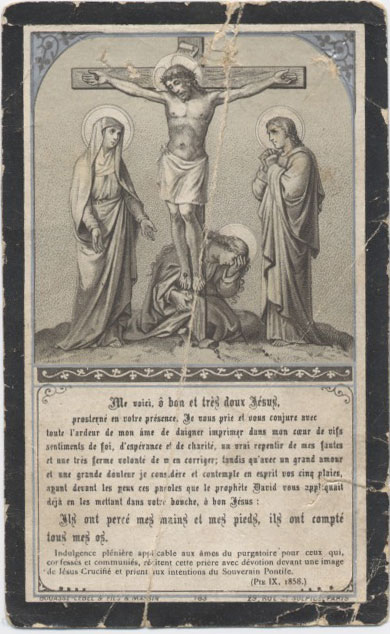
My grandmother showed me these funeral cards when I was a young boy. They seemed to come from another world, a context that had long-since faded away. They are a remnant of the Maine Franco-American culture as it existed in the early 20th century.

I am sure that many of my fellow Franco-Americans will nod in sympathy and familiarity with these cards, which they may have piled in a box or stuffed in a bottom drawer. 

For me these cartes mortuaires are precious relics. I can remember the reverence with which my grandmother revealed them to me, as if whispering a secret. Seeing them when I was young provided a small spark of inspiration leading me to take an interest in our family's past.

These cards represent my grandmother's maternal relatives all of whom came from what was then called the County of L'Islet, QC, the parish of Saint-Cyrille (also known as Saint-Cyrille-de-Lessard). The handwritten inscriptions on the cards are my Mémère's. She made these inscriptions in English so that her posterity would not forget her forbears.

I offer them without further comment, a moment of silence for our dearly departed.


I. Louis Bernier: uncle and godfather of Ida Lavigueur (Vermette)


II. Clarina Couchon: aunt and godmother of Ida Lavigueur

III. Arthur Bernier: grandfather of Ida Lavigueur

IV. Marie Saint-Pierre: grandmother of Ida Lavigueur

In October 2005 I visited Saint-Cyrille-de-Lessard for the first time and took the following photos. I'm not sure that any of the descendants of our line of the Berniers had returned to their ancestral parish since the times of our ancestors whose lives are commemorated above.

Here is a portion of the small parish of Saint-Cyrille seen from the hill on which sits the Church.
 

Aiming the camera just to left of the photo above, this picture shows a little of the Saint-Cyrille landscape.


Friday, October 12, 2012

Fears of Franco-American Conspiracy: Immigration and Paranoia

The fear of a French ‘papist’ horde descending from Canada to enslave New England was a common trope of the Revolutionary War period. In the late 19th c. the French ‘papist’ horde meme rose again like Lazarus from the dead.

The cause of this revival was the prodigious growth of French-speaking immigrants to the New England mill towns. This new round of hysteria represented these immigrant workers as the vanguard of a slow but steady movement to overwhelm New England and annex it to a revived New France.

This ‘popish’ plot was supposedly hatched in the chambers of the Québec Catholic hierarchy for whom the benighted workers were robotic foot soldiers in a sinister, international conspiracy. Ominous “secret societies” were mooted as contributing to these dark designs. The famed fecundity of the Canadien family was viewed as a tactic in a clandestine war.

A Boston paper epitomized the chief features of this theme as follows:

Romanism is already a terrible power in our country…To this...must be added the French ultramontane power…The French Jesuits have conceived the project of forming a Catholic nation out of the province of Quebec and New England, and this project of making New England French Catholic has already taken proportions capable of alarming the most optimistic. The French number more than a million in the United States...The number of their children is unimaginable for Americans…They are kept a distinct alien race, subject to the Pope in matters of religion and of politics. Soon…they will govern you, Americans.* [British-American Citizen, December 28, 1889]
The New York Times had put its weight behind the same view:

There is no evidence that the habitant or his [ecclesiastical] leader has thrown overboard a tradition that in the last few years has evoked something more serious than a smile from the average Anglo-Saxon. The tradition is that within a period not included within the present century there will be a country in North America called New France. It is to be constituted of Quebec, Ontario as far west as Hamilton, such portions of the maritime provinces as may be deemed worth taking, the New-England States and a slice of New-York. No effort is to be made to realize this tradition until the French race in America reach a certain number…so prolific is the French Canadian almost without exception. [January 13, 1889]
Three years later the Times repeated its warning in more strident tones:
Quebec is transferred bodily to Manchester and Fall River and Lowell. Not only does the French curé follow the French peasantry…he also perpetuates the French ideas and aspirations…and places all the obstacles possible in the way of the assimilation of these people to our American life and thought… These people are in New-England as an organized body, whose motto is Notre religion, notre langue, et nos moeurs. This body is ruled by a principle directly opposite to that which has made New-England what it is. It depresses to the lowest point possible the idea of personal responsibility and limits the freedom which it permits. It is next to impossible to penetrate this mass of protected and secluded humanity with modern ideas or to induce them to interest themselves in democratic institutions and methods of government…[the] migration of these people is part of a priestly scheme now fervently fostered in Canada for the purpose of bringing New-England under the control of the Roman Catholic faith… This is the avowed purpose of the secret society to which every adult French Canadian belongs, and…the earnest efforts of these people are to turn the tables in New-England by the aid of the silent forces which they control. [June 6, 1892]
The “secret societies” in question were similar to the Holy Name or St. Vincent de Paul Societies, chapters of which may still be found in some Catholic parishes. Those familiar with them will attest that they tend to engage in such dangerously subversive pursuits as charity bake sales or whist drives.

Their contradictions suggest that the theories surrounding the French 'papist' threat were ill-considered. The Franco-Americans are accused of taking no interest in American civic institutions and yet are said to hold a balance of political power in their communities.

They were pilloried as a transient population who would take their savings and go home without contributing to the United States. When they did settle and buy real estate they were accused of participating in a demographic manoeuvre to conquer New England.

A Contents Page from
Your Heritage or New England Threatened

(1891)
It was not only the newspapers that sounded the alarm. An entire book was published in 1891 entitled Your Heritage; or New England Threatened by Rev. Calvin E. Amaron. It is an extended improvisation on the French ‘papist’ horde theme.

This text speaks of the French-Canadian workers as an "invading force” to be “conquered.” It extends its martial metaphor throughout, while it fulminates against the evils of the “Romish religion” of French Canada. The Reverend insists on the “God-imposed” duty “to save this people” by converting them to Protestantism. “The safety of the nation demands it,” he declares.

Some of its allegations had a withered seed of truth. Bishop Laflèche of Trois-Rivières, QC had spoken undiplomatically in Springfield, Massachusetts of a greater francophone state which was to include at least parts of New England. 

But Bishop Laflèche did not speak for the entire Québec Catholic hierarchy, let alone the masses. He was in frequent conflict with his own Archbishop Taschereau, who held more moderate views, and his faction suffered the rebuke of Rome for its political meddling.

An organized, single-minded, French ‘papist’ conspiracy, complete with “secret societies,” was pure fantasy. Then why did the Yankees wax paranoiac about a mass of poor mill workers whose main concern was feeding their families? Other immigrant groups might be perceived as odious, as a nuisance, or as a "social problem." Franco-Americans were perceived as a threat.

One of the reasons was the contiguity between the USA and the Franco-American homeland. The motherlands of other immigrant groups, such as Greece, Poland or Italy, were not likely to covet a slice of American territory. A change in the northeastern border was at least theoretically possible.

As the press of the day also noted, the Greek, Polish or Italian immigrant had left his or her home definitively. The Franco-American could and frequently did return home where he or she was refreshed at the well-spring of the French Canadian folk. 

The Greek or Syrian immigrant of the period was an exotic figure whose religion and customs were a cipher to the 19th c. Yankee. The Canadien, however, was a familiar if indistinct character. The half-known and the half-understood provide excellent raw material for conspiratorial fantasies.

Another factor was the traditional enmity between New France and New England. The 19th c. Yankee's grandfathers and great-grandfathers had fought bitterly against New France, or at the Battle of Québec in 1775, or at Châteauguay in the War of 1812.

At root the sense of threat surrounding the Franco-Americans was founded upon the 19th c. Anglo-Saxon's assumption of a manifest destiny or white man’s burden to civilize barbaric and imperfect races.

How could the educated Yankees explain a group like the Franco-Americans who preferred to preserve their own language and culture even after 20 or 30 years of exposure to what they regarded as superior Anglo-American ways? How could they account for such impudence?

The answer must be culpable stubbornness, dense ignorance, or some nefarious plot. Or all of the above.
--------------------------
Much more in my book:
A Distinct Alien Race.
--------------------------

*Quoted in Mason Wade, The French Canadians: 1760-1967, vol. 1 (Toronto: Macmillan, 1968), 434.

Thursday, October 4, 2012

The Quebec Act: Forgotten Cause of the American Revolution


“For abolishing the free System of English Laws in a neighbouring Province, establishing therein an Arbitrary government, and enlarging its Boundaries so as to render it at once an example and fit instrument for introducing the same absolute rule into these Colonies.”

This text from the American Declaration of Independence refers to the Quebec Act of 1774. This Act of the British Parliament was one of the major causes of the American Revolution. New Englanders in particular feared that this law threatened the very survival of their political and religious institutions.

Religious ideology was at the heart of this imagined threat to American liberty. The religious controversy surrounding the Quebec Act opens a gateway to a forgotten story line in the narrative of the American Republic.

The former French colony of Canada, renamed the Province of Quebec, came under English rule following the Treaty of Paris of 1763. The intention of the 1774 law was to create a political and legal basis for a British province that was, at that date, almost entirely French-speaking and Roman Catholic.

The provisions of the Quebec Act and its subsequent mandates...
  • Restored the pre-1763 borders of the province, which included the Great Lakes region and the Ohio Valley
  • Reinstated French civil law, while it established English criminal law in the Province
  • Reestablished both the tithe for the Roman Catholic clergy and the traditional privileges of the land-holding seigneurs as a consequence of the restoration of the French civil code
With the exception of the imposition of English criminal law, these provisions reinstated Canada’s status quo ante. The Declaration of Independence, however, frames the Act’s provisions not as a revival of Quebec’s former customs but as an assortment of innovations both outrageous and dangerous:

“For abolishing the free System of English Laws in a neighbouring Province…”
This refers to the restoration of French civil law. The “free system of English laws”  had been in effect in the "neighbouring Province," and only partially at that, for a mere ten years or so prior to the Quebec Act. This "free system" was insufficiently established to speak reasonably of its abolition.

“establishing therein an Arbitrary government…”
The Quebec Act provided for an appointed council, rather than an elective assembly, to aid the governor’s oversight of the Province. A not dissimilar council had existed under the French Regime. This is the arbitrary government referenced in this clause. Rather than establishing arbitrary rule, the intent of the Act was to normalize the political and legal structure of the Province along lines familiar to its elite.

In fact, the period of British rule prior to the Quebec Act, which involved the refusal of its governors to implement the constitution in full, and the exclusion of most of the inhabitants from any role in civil affairs, might be liable to a charge of “arbitrary government.”

Province of Quebec 1774
Source: l'Annuaire du Québec, 1972
“and enlarging its Boundaries…”
Control of the Ohio Valley had been a casus belli in the so-called French and Indian War. Reestablishing the Province’s former borders allowed the Montréal merchants, via the Great Lakes, Ottawa, and St. Lawrence waterways, to compete with the Albany/Hudson/New York trade. The American colonists saw the territory that had been restored to Quebec as a natural field for their own western ambitions and resented its return to the Canadiens.

“…so as to render it at once an example and fit instrument for introducing the same absolute rule into these Colonies.”
Following a politicized construal of the Act's provisions, this language reveals the Americans' gravest concern. They feared that King George was sharpening his sword on Canada in preparation for the reduction of the American colonies to “absolute rule.” The colonists viewed what was in reality a pragmatic policy with regard to Quebec as a mere prelude to a tyrant’s gambit.

The phrase about Quebec becoming a “fit instrument” for the King’s supposed despotic designs touches on the Americans' darkest fears. What most exercised New England in the Quebec Act is that their Protestant king had not only tolerated but also established the Roman Catholic faith in “a neighbouring province.”  The next step, they feared, was that King George would unleash a French “papist” horde as his “instrument” for imposing a romanizing religion and government upon them.

In his book The Quebec Act: A Primary Cause of the American Revolution, Charles H. Metzger, S.J. argues that anti-Catholic bigotry with its fears of the French “papist” horde was by no means a minor subplot to the tea tax, the Stamp Act, and other American grievances. 

Writes Metzger, “[the] writings [of the American colonists] prove that to many of them the ‘Church of Rome’ was little less than the incarnation of evil; its adherents were thought capable of any crime; its creed was believed to be perversive and destructive of the very foundations of the social order.”*

In my next post I will explore in greater depth this picture of a French “papist” horde sweeping down from the North to extinguish Anglo-Saxon Protestant liberty. This meme was not only a major cause of the American Revolution. It also illumines the unique, virulent opposition faced by the French-Canadian workers who descended upon New England  in the 19th and early 20th centuries.

These latter-day Canadiens came not with weapons of war but with tools of labor. What I term the French “papist” horde meme, however, exerted so powerful an influence on the New England mind that these immigrant workers evoked anew the fears of 1774. I will show that the French "papist" horde image persisted for more than a century after the Quebec Act.

* The Quebec Act: A Primary Cause of the American Revolution, Metzger, Charles H., New York: The United States Catholic Historical Society, 1936, p 11.
My book A Distinct Alien Race is now available for pre-order