Showing posts with label Family History. Show all posts

Saturday, March 16, 2013

Family, History, and the Formation of the Heart

How is the heart formed?

By the heart I mean neither the physical organ nor the sentiments and affections but something deeper. In French the word for heart is cœur, which appears to be related to the English word core. The heart I’m speaking about is our psychological core, the center of our values and aspirations. It is by means of the heart that we perceive meaning. If we feel that something is worthy of our attention, valuable, meaningful or important it is by means of this metaphorical heart.

Inside this metaphor, it’s self-evident that different hearts function differently otherwise we would all have the same values and the same sense of what is meaningful, which doesn’t seem to be the case. What it is that we value or find meaningful is the result of a process of formation. How is one heart formed in one way while another is formed in some other way?

One day I noticed a stone beneath my neighbor’s rain gutter. I noticed how the stone had been smoothed by erosion caused by years of rainstorms. That stone had been formed by its “experience,” drop by drop, storm by storm.

At the risk of mixing metaphors, perhaps the heart is formed in an analogous way. At birth the stone has some rough shape but immediately the infant’s perceptions begin to form the stone, bit by bit, drop by drop. As we grow older the range of our choices grows and the choices we begin to make, and the responses to those choices, also form the heart. 

The scientific literature focuses also on such factors as genetics or birth-order. No doubt these play their role on the individual level, but do they account for the remarkable persistence of cultural traits at the level of the heart, at the level of the values that communities share?

In some schools of psychology the family system is seen as a crucible of the heart and thereby a conveyor of cultural values. My parent’s choices were a factor in the formation of the hearts of their children as their parents’ choices were for them. We discover a web of connected family systems that link back through a chain of history and causality. 
Carillon Sacré-Coeur Flag:
The Heart was a symbol with
immense spiritual power
in the traditional
French North American cultures

On the assumption that I know my grandparents and my grandparents knew theirs, the living memory of an extended family system reaches one’s great-great-grandparents. Generally, my great-great-grandparents were born in the 1820s. The collective memory of my extended family system stretches from 2013 to people whose hearts began to take shape in the 1820s. This is a rough estimate of a family’s effective historical horizon. 

Perhaps in all cultures but certainly in the Franco-American culture, stories play an enormous role in the process of forming the heart. Stories are vehicles for conveying who we are, what is important, and what ought to be done, especially when these stories are about our own family. The stories in my family that appeared as living memories did indeed extend to my grandparents’ grandparents.

For example, as a child I heard the tale of my great-great-grandfather Joseph Doucette and how he resisted with force and at the price of bodily harm what he regarded as an unjust economic and social system.

You can read Doucette’s story here and then I’ll ask what does a child learn from hearing a story like this not once but repeatedly? The story’s subtext makes clear that our people were the underdogs. “We” are not the ones with the power. “They” are. The rules are set by these others who have the power to establish systems in “their” interest and not necessarily in “ours.” A host of heart-forming messages are contained in such stories. 

I contend that even in families where specific stories have not come down from so distant a past, even if you have no idea who or what your grandparents’ grandparents were, these ancestors still haunt us. Their distantly echoing voices are still heard in the recesses of the heart through the messages we receive consciously or not from parents, grandparents, or others. The voices of more proximate generations are even louder and clearer.

We might borrow from engineering the notion of tolerances. Materials have certain tolerances to temperature and pressure, a degree of elasticity, etc. An aviation engineer is free to design an aircraft as he or she sees fit but only within the tolerances allowed by the materials as determined by the laws of physics. Similarly, as individuals we maintain substantial freedom of choice but only within the tolerances of the materials in our hearts.

History does not determine our choices but it does inform them. Many people choose to value what their forebears did not, but even these choices are not made out of context. Even if we recognize our tolerances and wish to transcend them, this transcendence is precisely of those tolerances. It is in response to them.

Here are some of the tolerances I’ve detected in my family system:

  • Authority comes from outside, from above rather than from within. We are not self-authorized but externally authorized.
  • Risk aversion: risk is seen from the standpoint of potential loss rather than potential gain.
  • One does not put oneself foward too much and one risks shame if one does. In a group situation it is important to feel out the context before making your contribution.

It requires little imagination to see how incompatible these assumptions may be with a competitive, aggressive, entrepreneurial, hyper-individualistic socio-economic system such as that of the USA. Although not all Franco-Americans share these tolerances, I would be very surprised if a sociological study did not find that such attitudes are shared disproportionately among this population as compared with some others.

Now that I’ve made them conscious I have won some freedom of choice with respect to these attitudes. But I cannot merely set them aside much less ignore them. Many raindrops through many storms formed the stony heart in the way in which it is formed. In a theoretically free society I have the theoretical freedom to transcend them. But to do so it is useful – some might say necessary – to understand the full weight of the history that informed them.

Our political or economic freedom, such as it is, does not mean that we are atoms floating in a void, only occasionally colliding in utterly context-free and wholly chosen transactions. We are not entirely self-determined but exist in context. Human beings exist within systems that include family, religious, and ideological systems as well as political and economic ones.

Choices are free within the tolerances allowed by a particular context within this network of overlapping systems. Our choices may be oriented toward changing one or another of these systems, but this is only possible by recognizing their character and scope.

If the past has no bearing on the formation of the heart then history is a frivolous discipline. It consists of stories that are perhaps entertaining but by no means important. If the experiences of our grandparents have no bearing on who we are now then I see little point in knowing about them at all.

If the experiences of generations past do not contribute to the formation of our hearts then what we call history is a mixed assortment of anecdotes about atomic individuals who made choices based on a self-created core that appears ex nihilo, unshared, and without the taint of context.

But this is no world that I live in. My heart was not formed to believe in such a world.

Monday, November 26, 2012

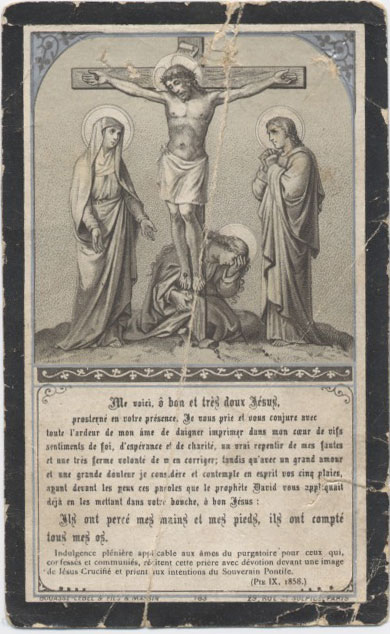
Cartes mortuaires: Funeral Cards of My Grandmother's Relatives

My grandmother showed me these funeral cards when I was a young boy. They seemed to come from another world, a context that had long-since faded away. They are a remnant of the Maine Franco-American culture as it existed in the early 20th century.

I am sure that many of my fellow Franco-Americans will nod in sympathy and familiarity with these cards, which they may have piled in a box or stuffed in a bottom drawer. 

For me these cartes mortuaires are precious relics. I can remember the reverence with which my grandmother revealed them to me, as if whispering a secret. Seeing them when I was young provided a small spark of inspiration leading me to take an interest in our family's past.

These cards represent my grandmother's maternal relatives all of whom came from what was then called the County of L'Islet, QC, the parish of Saint-Cyrille (also known as Saint-Cyrille-de-Lessard). The handwritten inscriptions on the cards are my Mémère's. She made these inscriptions in English so that her posterity would not forget her forbears.

I offer them without further comment, a moment of silence for our dearly departed.


I. Louis Bernier: uncle and godfather of Ida Lavigueur (Vermette)


II. Clarina Couchon: aunt and godmother of Ida Lavigueur

III. Arthur Bernier: grandfather of Ida Lavigueur

IV. Marie Saint-Pierre: grandmother of Ida Lavigueur

In October 2005 I visited Saint-Cyrille-de-Lessard for the first time and took the following photos. I'm not sure that any of the descendants of our line of the Berniers had returned to their ancestral parish since the times of our ancestors whose lives are commemorated above.

Here is a portion of the small parish of Saint-Cyrille seen from the hill on which sits the Church.
 

Aiming the camera just to left of the photo above, this picture shows a little of the Saint-Cyrille landscape.


Tuesday, August 14, 2012

Genealogy and Family History: Narcissism or Love?

Is it narcissism? Blinkered sentimentality? Is it nationalism of the exclusive and pernicious sort? Is this concentration on self, on my history, my family, my community anything worthwhile or am I self-deceived?

These are the questions, the doubts that trouble me in this family and social history project of mine. It is a project of self-discovery, self-recovery, and several other hyphenated descriptions beginning with the prefix self. It is a project about me and mine isn’t it?

A voice whispers, “Humble yourself. You’re not that important and your community’s struggles are not as weighty as those of others.” In our little known Franco-American subculture, humility is a family value, a value that serves us ill amid the din from today’s chorus of carnival barkers. 

I am sitting on the porch with a small group of my fellow French-Canadian descendants. There are about 20 of us and we’re attending a gathering in a remote conference center in Maine. Night has fallen after a day of presentations, readings, and discussions that leave us stimulated but exhausted.  This is our time to just hang out.

Franco-American Baseball Star
Napoléon Lajoie:
"Nap, comment dit-on 'can o' corn'?"
Jokes are told in French and English. Someone bursts into song for a moment only to be drowned out by raucous laughter following a muttered quip. Someone asks how you say “pinch hitter” in French. Another person grabs an iPad and looks it up, which leads to a quiz of baseball terms in French, each person talking over the other while everyone hears all that is said. “How do you say curve ball?” “How do you say grand slam?” I want to know how you say “can o’ corn” in French but I’m not quite sure what that means in English. Bilingual conversations and sidebars start, stop, dart, and scatter like aquatic insects.

This is the way Franco-Americans hang out. It is different from the way New England Yankees hang out, or Latinos hang out, or African-Americans hang out although if asked to define these differences I’d find myself on thin ice. I do know that it is as familiar as my own hand and as loveable as my best friend.

What are we doing in affirming this sameness, in basking in this familiarity? The obvious question to ask is whether this affirmation of sameness is about excluding the other. Are we building a Great Wall of self-identification in order to hold back the barbarians or is this something else?

“It’s about love. I love these people and they love me.” So said Cajun musician and poet Zachary Richard in the film about Franco-Americans, Réveil -Waking Up French. It’s about love, Monsieur Zachary, if we want it to be.

To recognize the sameness, to feel the love and familiarity we had with each other on the porch, is to build up a reservoir that we may take with us when we return to our multicultural world. Most of us no longer live in le petit Canada, the neighborhoods in pockets all over New England where French was spoken and our identity affirmed. On the porch, we recognize our humanity in a way that is easy so that we may build up a reserve of this rare form of energy in the moments when this recognition proves more difficult.

I can draw from these reserves in those moments when I perceive irreconcilable otherness, the irritating clash of competing, but closely held, values; when rage at our differences, at “how wrong you are!” covers over our sense of the humanity of the other. In these moments I may draw from the natural resource I mined on the porch.

It is in these difficult moments that I will resolve to draw from a time when it was very easy to affirm our humanity, our personhood, that oxymoronic unique-sameness that makes love real. This sameness may give us access to the other, access to the beauty in the diverse, the many, the multiple. Once our people milled cotton and wood and now we mill something else, drawing on another natural resource as essential to human life as wind or water. “It’s about love.” 

This conference I attended driven by an interest in our unique culture, our histories, the progress of our DNA contributors through history, need not be narcissistic or exclusive. This is not a Nuremberg rally telling the troops whom they ought to hate and why. A Christian teaching, almost never applied in practice, says, “Love your enemies.” I’m not the first person to ask how it is possible to love our enemies when we can’t even love our friends. 

What am I doing gathered with a handful of fellow Franco-Americans in this remote spot in Maine?  I’m learning to love my friends.

I won’t stop there.

----------------------
A Distinct Alien Race, a book by David Vermette from Baraka Books, Montreal, 2018

Monday, August 13, 2012

Of How Many Does a French Canadian Family Consist?

The following item appeared in the Brunswick (Maine) Telegraph, May 28, 1875, page two.

Of how many does a French Canadian Family Consist?
A few facts will furnish a reply. There is a family at work in the cotton mill, which consists of a father and mother and twenty-four children, all the children large enough being at work. The woman is the fourth wife; a brother of the husband living with his fifth wife in Montreal, has twenty-five children. Three families arrived here last week to go to work in the mill and they numbered all told 37 persons. A lady friend of ours a few days since met a Frenchwoman, who, looking at the babe in the carriage said to our friend, “I have got fifteen of those.” The only possible reply of the lady with the one babe was, “Oh Lordie!” Ten and twelve and fifteen children are by no means uncommon in the French Canadian families, but twenty-four are a little above average.
My great-grandfather was one of 23 children by two wives. Another great-grandfather was one of 17, all born to the same woman. As astonishing at this seems by modern standards we might bear in mind that family size is conventional. There is no normal family size and customs vary.

The Ouellettes And Their Twelve Children
The picture on the right shows my great-great-grandparents Thomas Ouellette and Josephine (Racine), seated in the center, with their adult children in 1909. These are not their children accompanied by their spouses. All of these people are their children. One of the children, Thomas Ouellette fils, is not in the picture since this photo was taken in Maine and he had returned to live in his native Québec by this point. Another child seems to have died before this photo was taken. I can confirm that Josephine bore at least 14 children and there may have been others about whom I don’t yet know. (My great-grandmother Albina Ouellette Vermette, b. Roxton Falls, QC, 1868 is seated at the far right.)

I am often asked why they had such large families. The usual assumption is that the children were required to serve as the labor force on the family farm. This may have been one reason for the custom of large families, particularly in the earlier days when land needed to be cleared and more hands meant more axes chopping down more trees.

Another reason for the large families was political and involved what was known as la revanche des berceauxthe revenge of the cradles. The idea was that the Francophones would retake Canada from their English conquerors by out-reproducing them. I’ve heard some stories of priests in the confessional asking fathers (mothers seem to have had little say in the matter) why they were not producing more children.

The revenge of the cradle backfired. The rapid population growth outstripped the economic/agricultural development required to support it. This strategy, intended to bring about demographic dominance, led to the departure of a large percentage of the population. Historians will continue to debate the point but it seems to me that the flight from Québec in the later 19th and early 20th centuries, both to the States and to other Canadian Provinces, was the result of an underdeveloped economy.

Given the economic and personal risk, the emotional toll, as well as the social sanctions against making such a move, it seems unlikely that the rural poor would have left la belle province in such numbers unless they were under duress. Many families auctioned off all they had to finance their trip to the States. That’s a risky, desperation move.

Another reason for large families is that children were a farmer’s retirement plan, his and his wife’s Social Security. Life expectancy was considered to be about 65 years for those who survived childhood. In order to enjoy a few years of retirement after a long life of hard work on the farm, it was necessary to produce a son who could inherit the property and support the habitant and his wife in their old age. This son would need to be grown, established, and able to take over his father’s farm by the time his parents reached about 55 to 60 years of age.

About a third of the children born alive did not make it to adulthood. If a couple’s first children were girls, they had to keep reproducing in order to have a son ready to inherit at a suitable age. Since there was a one-in-three chance that any son produced would die in childhood, the couple’s insurance policy, at least up until a certain point in life, was to keep reproducing as long as they were able.

These practical reasons were probably not uppermost in the minds of the parents of these families, however. Once the custom of large families was established it persisted by the inertia characteristic of traditional societies. It was accepted and normal in their world that a woman would be pregnant most of the time between ages 20 and 40. 

Although large families continued to be a custom in the Québec Diaspora in New England, the birth rate began to drop slowly when these families moved into an industrial economy. In these New England Franco-American families, the “revenge of the cradle” factor and the motive related to the traditional socio-agricultural system lost their relevance. The Franco-Americans may have been influenced also by the relatively smaller family sizes of their Yankee neighbors. That said, large families persisted in many Franco-American communities well into the 20th century. The birth rate in Québec did not decline until about 1960.

Saturday, August 4, 2012

A Monumental Discovery

 “We are not people who have their names on monuments.”

It was 2003 and my sister and I had taken a voyage to Québec. We were what she described aptly as genealogical tourists. We had traveled back in time, in reverse chronological order, to each of the towns where our paternal line had lived over a span of 200 years.  You can drive to all of these places in a morning and an afternoon. The final destination in our tour was Sainte-Famille, on the pretty island of Orleans, Île d’Orléans, near Quebec City. 

It was a beautiful summer evening. We had made this leg of our trip hurriedly, wondering if we could see Sainte-Famille before nightfall. Here, most likely on some other summer morning or evening in the 1660s, had landed a ship carrying our ancestor Antoine Vermet who had disembarked near here never to return to his native France.

Behind the church of Sainte-Famille, a structure from the days of the French Regime, we found a beautiful little park. In the park was a monument. At the top of the small structure, a human figure with branches for hands and roots for feet extended itself in a dance-like gesture. Below the figure was a list of names with the title “Les Familles Souches de l’Île d’Orléans” – founding families of Île d’Orléans. Among the names on the monument was Antoine Vermet. Among these names, my mother’s ancestor also appeared.

“We are not people who have their names on monuments,” I thought. But who are the people whose names are monumentalized, memorialized, carved in stone or engraved in metal, the hard surfaces that capture our collective memories?

I grew up in the Boston area, a place synonymous with storied American history. The place is so very monumentalized that each locality within Greater Boston has its local heroes and ours were the Adamses, Daniel Webster, and the Mayflower Pilgrims. These were the people who were remembered, this the cast of characters in stories told and retold.

The background of my family, textile and shipyard workers; railroad men and lumberjacks; machinists and factory foremen; farm women gathering and canning and sewing, these were not the people whose stories were told and there was, indeed, a vague embarrassment about them. They were “nobody special” and it was the “special” people, with names like Adams, Webster, Brewster, Cabot or Lowell whose names were monumental, worthy of commemoration and hence of admiration.

But here was evidence to the contrary. Here, at Sainte-Famille, was my story, our story, a story not so dissimilar to those Boston stories. It was a story of pioneers, sailors, soldiers, and voyagers. It was a story of women sent by the King of France with a mission to be the mothers of a new race. Through the violent death of the dream of a New France, with the slide of its habitants into the status of a conquered race, through rural poverty and hence ignominy, through a border crossing, the Vermettes and hundreds of thousands like them had entered the realm of Adamses, Websters, Cabots and Lowells.

What could be clearer evidence of the conquest of New France by New England than the fact that my great-grandfather Charles Vermette, eight generations after Antoine, came as a poor lumberjack to Brunswick, Maine to work in the Cabot Mill, a place whose principal partner was Francis Cabot, one of the famous Boston Brahmins whose surname is found on buildings at Harvard and monuments without end in New England?

The reddish gold of the setting northern sun struck the silver of the monument at Sainte-Famille, Île d’Orléans and shone on its list of names of the long dead but long remembered.   “We are not people who have their names on monuments,” I thought.

Here I stood in front of that thought’s incarnate contradiction.