Showing posts with label Child Labor. Show all posts

Monday, August 31, 2015

The Children's Strike In A Gilded Age Mill

“A little child shall lead them,” the Bible says. And so it was in Brunswick, Maine in 1881 when young boys not only participated in a strike at the Cabot textile mill – they caused the strike.

This curious tale is reported in the August 12, 1881 edition of the local newspaper, The Brunswick Telegraph (beginning on page 2). According to this report, drawn together from local sleuthing as well as from other newspaper accounts, a strike broke out among “the operatives in the spinning and mule rooms of the Cabot Company’s cotton mill…These strikes left the weavers short of working material and the mill was shut down.”

In response to the strikes that occurred on a Thursday in early August and again the following Monday, the Telegraph reports that the mill was closed apparently for the better part of a week, although the Telegraph’s account leaves the chronology uncertain.

The observation that young boys started the strike at the mill, extraordinary by modern lights, is tossed off at the end of the article in a single sentence. The strike began when “boys 8 to 14 years of age struck for higher pay, got it, and thus led to strikes in [the] spinning and mule rooms.” It was the success of the children’s strike that led the adults to hope for similar results.

The fact that it was the boys’ example that led the adult workers to strike is attributed to a report in the Bath Times “prepared by a reporter after careful enquiry.” However, “the operatives do not appear to have had any concerted action and moved apparently without leadership,” the Telegraph reports.
1894 Death Certificate of Adelard Duford
"Age: 11" "Occupation: Mill Operative"
Thanks Janine LaFleur Penfield

A.G. Tenney, the editor of the Telegraph and most likely the writer of the article in question, suggests a motive for the boys’ strike: “It is stated that the wages in the mill have been rather under than above the average of the cotton mills of this State, – that some of the young children work at $1.00 per week, and some as low as 8 cents per day, but this latter statement we are unwilling to accept.” Tenney gives no reason for his incredulity regarding the wages paid, although he attributes these figures to “outside talk.”

Tenney also reports that the workers demanded a ten percent raise, which they seem to have believed would put their pay in line with the wages at comparable mills in nearby Lewiston and Lisbon.

Don’t Call It a Company Store!
The Telegraph mentions that the grocery store “commonly known as the factory store” closed for at least one day in response to the strike. The proprietors of the mill, says Tenney, "denied all connection” to the store operated by “Messrs. Adams Bros.” The closure of the store in concert with the mill lock-out raised suspicions regarding this denial, notes Tenney.

The workers apparently had no doubt about the connection between the store and the Company since, reports the Telegraph, “some wicked wag…suspended [on the store] a red flag inscribed ‘Store closed,’ ‘Small pox.’”

The Telegraph also mentions “the payment of help through the system of orders” to the Adams’s grocery store, a system which, Tenney reports, many observers opposed. He attributes to the system's opponents “the general belief...that cash should be paid and the purchases made by the workman wherever he chooses to trade.” This “system of orders,” well-known enough to invite comment in the town, refutes the Cabot Company's denial of “all connection” between the store and the mill.

Another effect of the strike was that Benjamin Greene, the local agent of the mill, the face of the Cabot Manufacturing Company in the town, and the richest man in Brunswick, gave 30 day's notice to vacate to the residents in the company-owned tenements. Tenney justifies Greene’s action, stating that the notice to the tenants may have been “done as a measure of precaution if the strike holds on.”

As a rule, the mill workers in Brunswick in this period were housed in company-owned tenements. They were, to quote an 1885 New York Times piece about New England’s French-Canadians elsewhere in the region, “the despair of sanitarians.” This was due not to our ancestors’ slovenliness but rather to the failure of the likes of the Cabot Company to build an adequate infrastructure to house a population measured in four figures.

In fact, just a month before this strike, the Telegraph, generally a friend to neither Mr. Greene nor the Cabot Companyhad featured a lengthy piece about a Typhoid outbreak in these self-same tenements which was blamed on the Cabots' malfeasance. 

“French” = “Mill Worker”
The piece also makes clear that to be “French,” that is to say to be one of the French-Canadian immigrants in the town, is to be a mill worker in 1880s Brunswick. The paper reports that as early as the Wednesday following the Monday lock-out “several French families had left” implying that they did so in response to the strike. Tenney then states that on further investigation this report was shown to be untrue, but he notes that “some [French families] contemplate leaving.”

He also reports that, “no disturbance has occurred, the French people walking about the village, and lots going blue-berrying.” That was not an unwise move given the situation with the company grocery store.

The circumstances of the Franco-American workers in Brunswick in this period are by no means uncommon in the history of 19th c. Labor. Here we find an imported, foreign labor force housed by the same company that employs them, that then pays them, at least in part, not in cash but in orders from the company store.

The system of keeping the workers in a state of dependency appears to have faced some opposition within the town since it inhibited a potential market for local housing and retail trade. This was no small loss to the local economy since per the 1880 U.S. Census the Franco-American population of Brunswick comprised more than one-fifth of the town's headcount. But the Franco-American workers were in a closed circuit where the Cabot Company was their all.

It is not surprising that the French-speaking workers had recourse to the only tool at their disposal – the strike – but that they did not use it more often. Of course, strikes in that era came at great personal risk. Especially when the thirty-day eviction notice arrives at the worker's apartment as soon as the strike begins.

And in August of 1881, this risk was run because some eight-year-olds found out that the eight-year-olds over in Lewiston were pulling in perhaps a penny more than their measly dime a day.

For more on Franco-Americans in the textile industry please see my new book available here.

Wednesday, August 5, 2015

The Other Side of The Cotton: Franco-Americans in the Textile Industry

I saw a play a few years ago that touched on the 1912 textile strike in Lawrence, Massachusetts. The playwright had her main character name-check the various ethnic groups in the town, German, Irish, Italian, etc. No mention was made of the French-Canadians who were the second major ethnic group to reach the Merrimack Valley mill town. According to Donald Cole’s book Immigrant City: Lawrence, Massachusetts, 1845-1921, by 1890 the French-Canadian population comprised one-fifth of the immigrants in Lawrence (p 42).

There’s a consensus that the French-Canadian element in New England tended to shy away from organized labor in that period and this might explain their omission from the play’s script. Nonetheless, the relative invisibility of the story of the exodus from Québec to the New England mills, among the narratives of U.S. immigration history, is hard to fathom.

The truth is that the New England textile business was one of the bedrock industries of the USA and labor from French-speaking Canada was the bedrock of this industry. One can't second-guess history. But I’ll indulge the speculation that but for a large supply of cheap labor from North of the border, that industry might not have grown as it did, with untold consequences for the economic history of the USA. Any treatment of this industry's history which does not give adequate coverage to the phenomenon of Francophone Canadian immigration tells a lie by omission.

The book The Belles of New England by William Moran gets it right. This history of the textile industry has an entire, dedicated chapter about the Franco-Americans in the mills. It's one of the best short treatments I've read of the subject. However, other accounts lump the French-Canadians in with various other groups, as if they were all of equal importance to the development of this industry in the post-Civil War era. But this approach is not borne out by sources from the period, which indicate that the French-Canadian workers made a disproportionate contribution.

Fibre And Fabric: A Window Into The Textile Trade
Consider a textile industry trade journal of the period called Fibre and Fabric, a weekly, established in 1885 and published from Boston. You can peruse a bound copy of a number of editions from 1907 and into 1908 here. The importance, if not the dominance, of French-Canadian/Franco-American labor in this industry is evident throughout.
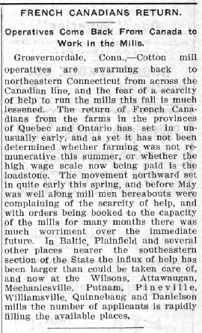
Migrant Workers Return
September 7, 1907, p 3

For instance, the return of the French-Canadian workers to their jobs in the Connecticut mills, after they spent the season tending their farms, merits special mention (right). This article fits the narrative that many of the Franco-Americans retained farms in Canada that they worked seasonally. They were migrant workers. This is by no means the only profile for the French-Canadians who came to work in the mills but it is an established narrative in the literature about them.

Further, consider this item from the August 10, 1907 edition of the trade journal:
Fall River, Mass.—Many of the mills, especially those in the eastern section of the city, are complaining of a scarcity of operatives in the ring spinning departments. Until recently these hands, who are mostly French-Canadian girls and boys, have worked pretty steadily, but now they have been attracted by the open-air life and vacations. The scarcity of small help is likely to continue through August, and is keeping the production down (p 20).
The nerve of the "small help" to prefer “the open-air life” to continuing as child labor in noisy, hot, and dangerous textile mills! What were the managers in Fall River to do without those French-speaking 8-to-10 year olds pulling their load!

This next item from the November 9, 1907 edition of the journal hints at the ethnic tensions in the mill towns as various groups vied for industrial jobs. The repatriation movement, which attempted to lure the Franco-Americans back to their Québec homeland on a permanent basis, was largely unsuccessful. But in this piece there’s evidence of repatriation without direct government involvement.
Biddeford, Me.—It is stated that the establishment of a new cotton mill at Three Rivers, Quebec, is likely to prove a serious handicap to the mill industries of this city, as a large number of French speaking loom fixers and weavers have applied for positions in the new Canadian plant. With the present scarcity of help, the manufacturers are finding it hard to find enough operatives to run the mills, and if a large number of experienced textile workers should leave it would mean an extensive curtailment of operations. The operatives are making the change because of a desire to return to their own country, where the French language is spoken, and where they will not have to compete with Greeks, as they do here (p 16).
"Situations Wanted"
The classified advertisements in the journal also demonstrate the importance of French-Canadian labor to the textile trade of the period.

In stark contrast to today’s practice, it was de rigueur for job-seekers to state their ethnicity. I examined classified ads for line positions placed through the journal's “Overseers Bureau.” I chose at random three editions at two month intervals (August 10, October 19, and December 7, 1907 issues). Out of a total of 190 ads in these three issues, about three-quarters (74%) identified their ethnicity as either “American” or “English.”  Not surprising in an English-language journal published from Boston.

Of the remaining quarter, about one-half (47%) of the advertisements were from the French-Canadian/Franco-American cohort, followed by Germans (27%), Scotch (16%), and Irish (4%), with one person claiming Belgian origins, one Polish-American, and one person who did not specify an ethnicity. Note the very small number of Irish-Americans, a total of 2 ads, both of which appear in the December 7, 1907 issue, and the complete absence of Italians from the issues I examined.

French-Canadians Seek Work
(August 24, 1907, p 21)

There are also instances in the 1907-8 journals where non-Franco-American advertisers tout their ability to speak French as well as English. Mentions of any other language are rare. French/English bilingualism was an important skill for the early 20th century “mill man.” It was as important in the textile industry in the Northeast of the time as Spanish/English bilingualism is today in many parts of USA.

Bilingualism a Plus
(August 24, 1907, p 21)
We see another advertiser who identifies himself as “English” searching for a position as overseer of spinners who describes himself as “a good manager of French help” (November 9, 1907, p 20). In a sharp reversal of the “no Irish need apply” syndrome, one Help Wanted ad for a “second hand for 200 looms running on cotton warps and worsted filling” specifies that the candidate “must be French, a good manager of help, and a hustler.” (September 14, 1907, p 18). In all likelihood someone “French” was required to work with the plethora of French-Canadian labor in this operation (location unknown).

Franco-American Labor: Fortune-Maker
We Franco-Americans in the Northeast USA tend to take a parochial view of our role in history. We focus on a family, or a community, or perhaps on a portion of a state. We do not think in sufficiently expansive terms. The truth is that we were a front-end of the wedge of American Industrialism in the post-Civil War period. 

Many Americans are well aware of the supply side of the cotton, how it was grown in the South and the labor conditions under which it was produced. We tend to think less about what happened to those bales of cotton after the harvest. The truth is that Franco-American men, women and children were the other side of the cotton in the period from about 1865-1930.

It is our ancestors’ labor, in the main, that turned that raw material into finished product, making fortunes for the Boston Brahmins who controlled this industry through the Gilded Age. This was in addition to the fortunes these families had already made in previous generations and that afforded them the capital to import a large labor force from French Canada.

As the articles above make clear, labor was in demand and the Brahmin owners fretted about losing us to Canadian mills or to our ancestral farms. They needed our forebears very much, including "the small help." The existence of a large supply of cheap labor on the borders of New England made the textile industry possible.
---------------------------
More about Franco-Americans in the mills:

Monday, December 29, 2014

Video Presentation: The Cabot Mill and Brunswick, Maine's Franco-Americans

This is a video of a presentation I delivered in April 2014 through the auspices of the Pejepscot Historical Society of Brunswick, Maine. It details the development of the Franco-American community in that town and the history of the textile mill that began to bring French-Canadians to Brunswick in the mid 19th century.

Among other topics I discuss:
  • Reasons for the exodus from rural Québec
  • Chain migration from L'Islet, QC to Brunswick
  • Conditions in the company-owned housing
  • The background of the Boston Brahmin mill owners
  • The steps the Franco-Americans took to improve their lot in adverse conditions
This talk covers some of the research I have written about before (for example here and here) but includes research and graphics that I have never before published.

I hope you have time to sit back and enjoy this presentation.


Thursday, August 2, 2012

The Case of the Cabot Mill

In the manuscript United States Census for Cumberland County, Brunswick, Maine for the year 1880, I find the family of my great-grandmother, Albina Ouellette (b. February 1868, Roxton Falls, Québec). The census reports that Albina, age twelve, her father, and seven of her eleven siblings, including her ten-year-old younger brother, worked in the Cabot Manufacturing Company textile mill. The census for Brunswick in that year contains approximately twenty continuous pages of French names. Almost all of these individuals were born in Canada and were employed by the Cabot mill. There is little doubt that the area of Brunswick represented in these pages is what is referred to in contemporary newspaper accounts as “the French Quarter” or “the French locality.”


In 1886 a serious outbreak of Diphtheria would spread through the French Quarter of Brunswick. This disease, which is associated with overcrowded and unsanitary conditions, would spread to at least 142 individuals, mostly French-speaking children, between April and September of 1886. I estimate that somewhere between eight and ten percent of the French-speaking group in the town became infected with the disease.

Mr. A.G. Tenney, editor of the English-language newspaper, the Brunswick Telegraph, mounted a campaign in his paper against the Cabot Company, which lasted several weeks and detailed the poor conditions that prevailed in the company housing in the “French locality” at that time. I will quote one passage from this series at length:

The houses are built in close contact; there are no yards; the sheds and privies are near by; the drainage – the sink spouts are running only a few feet or so outside of the houses where all dirty water is poured out – falling on the surface of the ground, some of which drains into the cellar and leaves one of the most prolific sources of disease. The houses have from two to three stories, some of which are divided into eight tenements; the average number of people is about twelve in each tenement (96 to a house); the number of rooms in each is from five to seven; bedrooms are small, many of which have only one window where there are two beds. This will give you an idea of the amount of dirty water and slops that are poured out on the surface, close by the block – leaving the most offensive odor that can exist. These large blocks are accommodated with only four privies – giving about twenty five people for each privy – and those privies are cleaned only once a year, and this is done during this present hot weather of July. These places have overflowed since the month of May.

Swine, cows, and hens are kept in the sheds, pig-pens in close connection with wood sheds &c. – giving additional offensive odor. The wells are in the midst of this filth, some of which are not more than twenty feet distant from the sink spout and privies. Sandy soil as it is in this place there is no doubt that some of these wells receive the slops in a few days after their pouring out of doors.

The collection of refuse matter in or around the dwelling houses, such as swill, waste of meat, fish and decaying vegetables, dead carcasses are all present, giving or generating disease germs, affecting the purity of the air; – they should be considered the worst kind of nuisances. Such nuisances one should be compelled to remove or dispose of either by burial, burning or otherwise. Now then, summing up in a few words the above mention will show the favorable condition for any contagious disease to spring up.
[Brunswick Telegraph, July 30, 1886]

Doctor Onesime Paré (b. June 1854, St-Gervais-de-Bellechasse, Québec) provided the Telegraph with descriptions of these conditions, as well as other information regarding the extent and spread of the disease. Doctor Paré and Mr. Tenney should be remembered for the efforts they made to draw attention to the deplorable housing conditions in the tenements. In the newspaper, the evidence of other (Yankee) doctors is brought forward to corroborate the facts as presented by Tenney.

For further corroboration, we may examine the statistics for burials at St. John’s church. William N. Locke, in his article, “The French Colony at Brunswick, Maine: A Historical Sketch” (Les Archives de Folklore, 1 (1946, pp 97-111), provides statistics on burials from this parish in the years 1877-1895. There is a sharp spike in the number of deaths among the French-Canadian community in the years 1886 and 1887. That this increase in mortality is not a natural consequence of an increase in the French-Canadian population during these years is demonstrated by the fact that there were nearly half as many burials in 1888 (41 total) as there were in 1886 (81 burials).

The sad truth is confirmed by an examination of the handwritten vital records kept by the Town of Brunswick. Here I found that 35 children died between April and September of 1886. The records, in most cases, do not state the cause of death, but, in a few, Diphtheria is cited explicitly. That the majority of these children were the victims of the Diphtheria epidemic we may surmise, apart from the newspaper’s testimony, by examining child mortality rates in the years on either side of 1886. The records reveal that nine children died between April and September 1885. In 1887, 18 children died in this same span of months.

These records also show that Diphtheria, in that summer of 1886, was not an equal opportunity disease; without exception the children who died that spring and summer had French names.

In reading the Brunswick Telegraph’s increasingly shrill outcries against the Cabot Company and its directors, I can’t help but imagine my great-grandparents and my great great grandparents, Thomas Ouellette (b. March 1836, Ste-Anne-de-la-Pocatiere, Québec) and Josephine Racine Ouellette (b. March 1842, St-Charles-de-St-Hyacinthe, Québec), or their relatives, friends, and co-workers living in such conditions. Did my great-grandmother Ouellette hear the cries of the children who had the disease? Or were the infected children too sick to cry out? Did she see the lesions caused by some forms of this disease? Did she attend the funeral of a neighbor’s child?

It’s quite likely that she did. Comparing the names of the children who died with the data provided by the 1880 census, and assuming that the cast of characters involved lived in the same places in 1886 that they did in 1880, I can confirm that children were dying all around the location where my great-grandmother lived.

The census enumerator in 1880 designated the Ouellette’s residence, in order of visitation, as dwelling 25. Two-year-old Marie Claire Ste-Marie and her eight-year-old brother, Alexis Albert, died on the same day, April 13, 1886. The census indicates that this family lived in dwelling 23“Cause of death: Diphtheria,” the town records report. Ten-month-old Joseph Desjardins died on August 26th; this family lived in dwelling 27. Nine-year-old Rosa Leblanc died on June 30th; her family resided in dwelling 29. The census also reveals that no less than thirty-one individuals lived in dwelling 29. On the assumption that these families stayed put between 1880 and 1886, I conclude that my 18-year-old great-grandmother was well aware of the dying children during these spring and summer months.

But when I recounted this history to others, even to my own family, the deflection mechanism went into full swing. The response was to try to justify the brutality our ancestors suffered.  What purpose does the deflection serve?

To answer some of these attempts at deflection, from the Telegraph’s account it is clear that Tenney had some confusion regarding the precise cause, but he was correct that overcrowded conditions are favorable to the outbreak and proliferation of the disease. The fact that the conditions in the tenements were not business as usual is attested to by numerous quotations from Tenney’s articles. For example, in the same article quoted above, Tenney describes the conditions as representing “a degree of brutality almost inconceivable in a civilized community.” Two weeks later, Tenney writes:

We only wish that the Boston Cabot gentlemen could listen to the biting denunciations of them as notorious (at least in the case under discussion) for their filthy greed, by gentlemen, we can tell them who, as manufacturers, are their equals in experience, perhaps in wealth, but infinitely their superiors in all that goes to make up the true man, regardful of the lives and health of the men and women whom they employ. Some of these manufacturers…are downright wrathy over the reflection cast upon all other manufacturers by the abominable neglect of Cabot company Directors, to remedy a state of things which no man here dares to deny exists.
[Brunswick Telegraph, August 13, 1886]
  
In the final article in the series, Tenney’s rhetoric against the Cabot Company and what he terms “the disgracefully neglected Cabot homes” reaches a crescendo leaving no doubt about how his newspaper viewed the Cabot Company and the condition of “the French operatives” of the mill:

[Its] record should consign to eternal infamy the management of this corporation, more heartless than the Fejees of old, who in hot blood, murdered their prisoners, then roasted and ate them. The Cabot Company has no such tender mercy for the poor slaves bound to it by the necessities of existence, they dying by slow poison germinated in the filth permitted by the company’s home management to flow over the soil in reeking streams from the vaults of the boarding houses, the poor people inhabiting them being powerless to secure relief.
[Brunswick Telegraph, August 20, 1886] 

From these passages it is plain that such conditions were not what was expected in those times since they were denounced as exceptionally bad even by those of the same occupation and “station in life,” as the “Boston Cabot gentlemen.” These extracts also show how at least one educated Yankee of that period regarded the French-Canadian/Franco-American mill worker of his day. The “French operatives” in the mill were, in Tenney’s view, “poor slaves” bound to the mill by “the necessities of existence”; they were “poor people…powerless to secure relief” from the disease and the conditions that contributed to it.

And the poor housing conditions had prevailed for years prior to 1886. Typhoid Fever – which is contracted through drinking water polluted by human excrement – had passed through the French Quarter in 1881 five years before the Diphtheria epidemic; it would have a return engagement in 1887. Tenney, in his 1886 series on the Cabot Mill, says that the same conditions had existed in the worker’s housing for 15 years, that is, since the early 1870s, when French-Canadians had started arriving in Brunswick in significant numbers. It was not a brief episode due, as was suggested to me, to the fact that the directors of the Cabot Company “didn’t really know what was going on.” I suspect they knew full well. Their local agents most certainly did. Their noses couldn’t lie.

The fact that French-Canadians continued to cross the border to work at the Cabot Mill, as they did during these years of the 1870s and 1880s, is more a statement about the desperate conditions in rural Québec in the late 19th century than it is proof that things “must not have been so bad.” Things were so bad. Necessity drove them into the mills anyway. Choices were few, and good choices were fewer.

For more on Franco-Americans in the textile industry please see my new book available here.
This post is excerpted and edited from my article called "French Pride and the Question of Repression" originally published in Le Forum mars-avril/March-April 2004.