Showing posts with label Textile industry. Show all posts

Monday, December 28, 2020

An Attempt at a French-Canadian "Colony" in South Carolina

Before the pandemic, I gave a presentation in a private residence to a small group in Maryland. I enjoy telling my Québec/New England-based stories outside of the region because audiences have fewer preconceptions and ask surprising questions. At this presentation in Maryland someone asked why the Franco-American textile workers in New England didn’t move to the Southeast when the industry began to relocate there in the early 20th century.   

I’m sure there was no large-scale exodus of Franco-American labor from New England to the South in that period. But I have found evidence of at least one attempt to lure them southward.

A French-Canadian “Invasion” of the South in 1903


The New-York Daily Tribune, in its May 7, 1903 edition, reported on an attempt to establish a French-Canadian “colony” in Dixie.
FRENCH CANADIANS INVADE SOUTH.
A Project to Establish Colonies in the Cotton Belt.
Washington May 6 (Special).— A party of well to-do and influential French Canadians passed through Washington last night, bound for the South where they will make an extensive examination of the cotton belt with a view to selecting sites for one or more French Canadian colonies. It is expected that this will prove to be the beginning of an extensive immigration of French Canadians who have been attracted by the glowing accounts they have heard of the Southern States, and, impressed with the establishment of extensive cotton mills where the younger members of their families can find employment, are seriously contemplating the purchase of extensive tracts of land, which will be used by the older colonists for agricultural purposes.
Exactly who these “well to-do and influential" French Canadians were I haven’t yet ascertained, but their plan was clear. Many of their compatriots in the States had come from farms in Québec and planned a return to agriculture by heading south. The younger generation, many of them having worked in the mills of New England, would find employment in the South’s growing textile industry. 

The following piece from the Batesburg (South Carolina) Advocate of September 30, 1903 alludes to the Spring visit of the French-Canadians and gives further details about their plans. These Canadiens, it appears, were arriving via Massachusetts.
A COLONY LOCATED.
A Lot of French Canadians to Settle Near Summerville [South Carolina].

A PIONEER BAND HAS ARRIVED,
And Are Now Engaged In Building Homes at the New Settlement, Others Will Follow Soon.

The News and Courier, of Thursday, says that Mr. L. Scott Allen, who is connected with the land and industrial department of the Southern Railway, with headquarters in Washington, arrived in Charleston Wednesday morning and immediately afterwards went up to Summerville. Wednesday night he returned to the city and is located at the St. John Hotel. His visit to this section is in the interest of a colony of French Canadians which is to be established on the line of the Southern Railway near Summerville, and all of this is a direct result from a visit paid by a number of French Canadians last May.

It will be recalled that early in the spring a party right from the manufacturing districts of Massachusetts visited Charleston under the chaperonage of Mr. Allen, and inspected the lands here and at Summerville. They seemed much pleased with conditions and prospects and indicated that they would consider the advisability of bringing a large number of their countrymen, French Canadians, then working in the mills, to the Sunny South, where they could once more engage in agricultural pursuits as they desired.

The first of the colonists have arrived, the contingent numbering two families, 10 persons in all. The site of the colony is about a mile and a half out of town and Civil Engineer Hale of the Southern railway put its services at the disposal of the colonists in running the lines for the fences and houses. The contingent is just an advance corps of the many people who will arrive here next month and in November from Canada and New England.

The Southern railway land agents have arranged to bring large numbers of Canadians south, to settle at various points in South Carolina and the Summerville colony will be one of the largest and most encouraging. Land Agent Scott Allen of the Southern has the particular colony in charge, is accompanying the pioneers, and will be here for several days assisting them in their settlement. The Canadians are all a fine class of people and their arrival in Summerville means a big thing for the town and vicinity. The Canadians will engage extensively in farming and raising cattle. They will build their own schools and churches and the colony will be a settlement of some proportions and importance.
This account of the settlement, which was to include French-language schools and churches, suggests that the plan was for the "colonists" to form self-contained, French-speaking neighborhoods, like the enclaves they had established in New England’s industrial towns. The French-Canadian organizers were planning to move the “Little Canada” from Massachusetts to South Carolina, just as a previous generation had 
moved the Québec parish from Canada to New England. 

However, the Southerners regarded the Canadiens as “a fine class of people” a positive regard not often shared by their Northern compatriots. Or perhaps the promoters wanted both the French-Canadians and the locals to believe that there was positive regard. 

Promoting The South 


The Southern Railway promoted agriculture and industrial development in the Southeast with vigor. Railroads in the 19th century were often given land grants by governments and these lands were managed as potentially profitable assets. Railroad companies, especially in the West, had land management offices that promoted the development of towns and industry along their routes.

Burke Davis’s history of the Southern Railway [The Southern Railway: Road of the Innovators, Chapel Hill: University of North Carolina Press, 1985] claims that the railroad’s president Sam Spencer tied the economic development of the South to the future of his business. He hired M. V. Richards, "a resourceful promoter," to lead his "land and immigration" department. The L. Scott Allen mentioned in the 1903 Batesburg Advocate piece was Richards’s 
Boston-based colleague.

Promising "cheap and contented labor."
Southern Railway ad 

in textile trade journal 
Fibre and Fabric
Jan. 22, 1898.
Davis recounts how Richards's office promoted the Southeast through a regular bulletin (printed in English, French, and German) with information about the rich opportunities available; through leading influential parties on Southern junkets; and through exhibits at fairs and expositions. Richards took his PR campaign to Canada and Europe, as well as to various parts of the U.S. 

Davis also notes that the Southern Railway encouraged the “migration of the New England textile industry to the South” through an “aggressive program.” The proceedings of the New England Association of Cotton Manufacturers confirm these promotional efforts.

In the Autumn of 1897, Richards wrote to the Association, then convening in Philadelphia, offering to sponsor them on a tour along the Southern Railway to survey the opportunities for the cotton textile industry in the South. Then President of the Association, Russell W. Eaton, Agent of the Cabot Manufacturing Company of Brunswick, Maine, took a group of twenty Northern 
cotton manufacturers, a few accompanied by their wives, on the week-long train ride. 

Embarking on Friday, October 29, 1897 from Washington, D.C., and returning there on November 4, the small party was feted throughout Virginia, North Carolina, and South Carolina, with stops for site visits at mills and other attractions along the way.

The excursion of the “well-to-do” French-Canadians that L. Scott Allen led in 1903 was probably not dissimilar to the trip Eaton and his cotton manufacturers had taken six years earlier. Such promotions, claims Davis, did bring "colonists" to the area. He found that the railway's efforts led to “a substantial influx” to the region “including colonies of some size” consisting of European immigrants: Germans, Swedes, North Italians, Czechs, and Hungarians.

The Colony That Wasn’t


An influx of French-Canadians, however, the vaunted “big thing for the town” of Summerville, South Carolina, never occurred. Despite the detailed plans, there was no significant resettlement there of French-Canadian workers from “the manufacturing districts of Massachusetts.”  

The U.S. Census of 1910, seven years after the fervor of 1903, finds only three French-Canadian families, totaling nine people, in Summerville and neighboring Dorchester township. The family names are 
Bessette, Gaumont, and Quintal. 

All but one of these nine were born in Canada, the exception being 9-year-old Theodore Gaumont, born in Massachusetts. This detail suggests that these three families may be all that was left in 1910 of the 1903 attempt to resettle Massachusetts Franco-Americans in the South. 

These three families do not appear to be living in close proximity to one another which suggests that the dreams of 1903 for a tight-knit French-Canadian neighborhood never materialized. 

The three families are likely to have seemed quite foreign in the Summerville of 1910 where almost everyone was born in South Carolina, as were their parents. Per the abstract of the U.S. Census, 94.4% of the population of South Carolina in 1910 was born in that state (second only to North Carolina in that category). Only 0.4% of South Carolinians were foreign-born. This contrasts sharply with Massachusetts in 1910, where 55.3% of the population was born in that state, while 31.5% of the Bay State's residents were born outside of the U.S. 

The same abstract of the census records only 39 people born in French Canada in the entire state of South Carolina in 1910. The three families living in Summerville/Dorchester township make up nearly a quarter of the state's entire French-Canadian contingent.  

The French-Canadian families in 
Summerville/Dorchester township practiced agriculture. Two of them owned farms, while one family rented theirs. The couples that founded these families were in their 50s and 60s in 1910, except for the Gaumonts who were in their 30s. The census data would tend to confirm the detail in the 1903 Tribune piece that the proposed Summerville development was to include “older colonists” seeking a return to agriculture. 

Two of the heads of household of these French-Canadian families were naturalized U.S. citizens, while the third, “Moses” [Moises] Quintal, was neither naturalized, nor could he and his wife speak English. They had two adult daughters who could speak English and probably they enabled the family to function in Summerville.

But the French-Canadian families did not stay in the Summerville area. As far as I can tell, by 1920 they were gone. The fate of two of the three families after 1910 is uncertain, but I see no evidence for their continued presence in the vicinity by 1920. 

The Gaumonts appear to have given up on the farming life to return to the mills. The 1920 U.S. census finds the Gaumonts in New Bedford, Massachusetts. The male head of household worked as a loom fixer in a cotton mill, where his wife and their now 19-year-old son were weavers. They abandoned the southern experiment and returned to the North.

Railway station in Summerville
circa 1935-40
For unknown reasons, the “colony” of French-Canadians in Summerville fizzled. The Francophone school and church were never built. Younger generations never took jobs for any length of time in local textile mills. Within less than 20 years, nothing would remain of this attempt to bring French-Canadian farmers and textile workers from New England to the South. 

Were there other such attempts? The Tribune piece of 1903 suggests as much. Further research awaits…

Friday, March 22, 2019

Exams of Franco-American WWI Draftees Show the Poorest State of Public Health in the U.S.

On February 20, 1923, Charles B. Davenport of the Eugenics Record Office in Long Island, NY, wrote a letter to Henry F. Perkins, eugenics point man at the University of Vermont. “Did you know,” wrote Davenport to Perkins, “that in the study of defects found in drafted men, Vermont stood at or near the top of the list as having precisely or nearly the highest defect rate for quite a series of defects? This result I ascribe to the French Canadian constituents of the population which, I had other reasons for believing, to contain an undue proportion of defectives.”1

Davenport knew well the “study of defects found in drafted men” because he co-wrote the detailed statistical report on the subject for the Senate Committee on Military Affairs.2  This 1919 report of more than 350 pages compiles data from medical examinations of 2.7 million men, 18 to 30 years old, drafted during the First World War. Examiners reported cases of what they regarded as mental or physical “defects,” which included a wide range of diseases and conditions from heart disease, to asthma, to blindness, to flat feet, to obesity, to drug addiction.

The report cuts the data three ways. First, it reports the distribution of these “defects” among the states. It then divides most of the states into smaller regions that reflect different economies: agricultural, manufacturing, mining, or commuter regions. There is also a similar series with the data grouped by environment or terrain: mountain, desert, maritime regions, etc. In these analyses, the researchers attempt to group the various health issues according to the draftee's occupation or milieu.
"Defects Found in Drafted Men." 1919 report by Albert G. Love  and eugenics supporter Charles B. Davenport
1919 report by Albert G. Love
and eugenics supporter Charles B. Davenport

Then comes what the researchers term “the racial series.” These “races” include groupings like “mountain whites,” “Indians” (Native Americans) and “Mexicans.” There is also a number of breakout groups of “foreign born whites.” “Group 19” is the French Canadian “racial” group.

This group was created, like the other groups, by aggregating areas with high concentrations of French-Canadians, where the latter constituted more than 10 percent of the population. All such regions were in New England, in the states of Maine, New Hampshire, Massachusetts and Rhode Island. The French-Canadian group had “the highest defect rate” of any of the “racial” groupings in the U.S. (266). Areas with high concentrations of French-Canadians led the lists in a range of health problems associated with low socioeconomic status including alcoholism, malnutrition, and obesity. 

Presenting their findings on “Group 19,” the researchers state:
The French Canadian group shows an extraordinary excess of defects in various important respects, such as tuberculosis, spinal curvature, deaf-mutism, mental deficiency and psychoses, refractive errors [myopia and other eyesight issues], otitis media [inflammatory diseases of the ear], defective hearing, asthma, bad teeth, hernia, deficient size of chest, and height and underweight. The sections of which the French Canadians form a predominant factor are among the poorest from the military standpoint (46).
The French-Canadian group led the U.S. in alcoholism. Alcoholism was high across New England in 1919 and not only in the areas with high concentrations of French-Canadians. Of the ten states with the highest numbers of alcoholics among drafted men, five of them were in New England (86, Table 12). However, in the parts of New England with large French-Canadian populations, rates of alcoholism were many times higher than elsewhere. The rate of alcoholism among young men in the French-Canadian parts of New England was 0.91 per 1000 persons. By contrast, populations such as the Germans/Austrians and Russians in the U.S., stereotypically thought to enjoy a drink, had rates of alcoholism of 0.38 and 0.21 per thousand respectively (269, Table 106).

The French-Canadian grouping also had the highest rates, by far, of men judged “underheight” and “underweight” (294, Tables 180, 181). They also had the highest incidence of diagnosed malnutrition except for “mountain whites” and “Indians” living in “sparsely settled” places (294, Table 182).  Anemia, a condition often caused by vitamin or mineral deficiency, was found to be “exceptionally high in the French Canadian section(s) (305).” At the same time, the highest rates of obesity in the U.S. were found in places with large French-Canadian populations (272, Table 114).

The “French-Canadian immigrants” were also found to suffer from a high proportion of “defective physical development.” But exactly how this condition is defined and how it differs from “underweight” is unclear even to the researchers. However, the rate of “total defective development and nutrition” among the French-Canadian group was many times higher than that of any other group listed: 85.26 persons per 1000, as compared with the next highest numbers among Scottish-Americans and “mountain whites,” with about one-half the rate of the French-Canadian group. The researchers own that “defective development” “is due to a variety of causes (33-34). Since Davenport was a eugenics supporter, the report often wishes to find a “congenital” or “racial” cause for some alleged “defect.” But it admits that “defective physical development” has environmental components.
The group [showing ‘defective physical development’] has a great importance for social therapeutics, since it is largely due to unhygienic methods of living, although in considerable part due, also, to congenital defects…. A center for defective physical development is found in the States which center around Chattanooga, and it seems probable that this area is largely determined by the presence of hookworm infection. There is another center in New England, and this seems to be controlled very largely by the French-Canadian immigrants, who show a high rate of defective physical development (33-34).
“Unhygienic methods of living” are blamed for the undernourished conditions of young men in the mill towns, and not the socioeconomic conditions that had turned the rural poor of Québec into a neglected labor pool destined for U.S. mills and factories. Whether the causes were congenital or environmental, many of the young men who came from the mill town milieu were no longer physically fit even for the trenches.

Having found that the French-Canadian group scored highest in a wide range of alleged “defects,” the authors then attribute the poor showing of some New England states to high concentrations of French-Canadians. 

Rhode Island had the highest “defect rate” overall. Conditions in which Rhode Island stands first or second are: Alcoholism, obesity, neurosis, total for myopia and defective vision (cause not stated), hemorrhoids, bronchitis, deformities of appendages and trunk, atrophy of muscles of the appendages, underheight, and underweight (41). Why does Rhode Island stand at or near the top in many “defects,” per Love and Davenport?
It is largely because of the defective or nonresistant stock which has been drawn to this the most urban of all the States—that in which the population is most generally engaged in manufacturing. While one may not ascribe the defects to the occupation, it is probable that the occupation has attracted stock with defects or susceptible to them. Next to Rhode Island stands Vermont....It is surprising in what a number of defects the small State of Vermont leads. The reason for this is probably because of the presence in Vermont of a large number of French Canadians in whom the defect rate is particularly high (41).
Love and Davenport ascribe Rhode Island’s high “defect rate” to “defective stock” attracted by the state’s manufacturing, while Vermont’s is attributed to its “large number of French-Canadians.” However, elsewhere in the report, the authors find that these two states “have this in common that they contain a large proportion of Canadian French (149).” More than once, they claim that the reason for these states' poor showing is the French-Canadian presence. 

The authors discuss some problems with the hypothesis that New England’s health woes were due to “defective” French-Canadians. They observe that New Hampshire had a larger percentage of French-Canadians than either Rhode Island or Vermont, and yet it was in the middle of the pack as regards alleged “defects.” The authors conclude that the “high position of Rhode Island and Vermont” with respect to “defects” is “due to a combination of...three factors...the thoroughness of the examinations made by local boards, the intelligence and care exercised at Camp Devens [where New England draftees were examined] and the high percentage of French Canadians in the population (149).

Conditions that were environmental, a consequence of living in fetid mill towns, are ascribed to “congenital” causes. These conclusions were then used  by eugenics proponents, like Davenport and Vermont’s Henry Perkins, to class the French Canadians as an "inferior" breed in their racial hierarchies. Since French-Canadians in the mill towns were poor, they faced public health challenges; these challenges were then essentialized by eugenics proponents and made a part of the “racial” (their word) makeup of the French Canadian people.

Among the alleged “defects” that stemmed from life in the mill towns were problems with eyesight, hearing, and respiratory issues. And these health problems appear already in young men mostly in their twenties. High rates of obesity, malnutrition, and the off-the-chart rate of alcoholism show a community that’s been marginalized by the society of its day and relegated to an underclass status. Such a status, in all times and places, is hazardous to one’s health.

French-Canadians of New England in WWI uniforms
My maternal grandfather (right)
and his brother in their WWI uniforms
The data from drafted men paints a shocking portrait of the Franco-Americans in the mill towns in the early 20th century. They emerge as among the most disadvantaged groups in the U.S. from a public health perspective. When compared with groups recognized as poor or historically disadvantaged, such as mountain whites, rural Native Americans, and Mexican-Americans, the data shows the tragically poor condition of public health in the New England mill towns where the French-Canadians predominated.

Both of my grandfathers were in the military in the World War One era and they were both born and raised in the areas Love and Davenport have aggregated to create their French-Canadian “racial” group. Their data provides insight into the world of my grandparents, the places where they were born and raised. My father was born less than a decade after the report on drafted men was issued, in one of the heavily French-Canadian areas of Maine. The “defective” French-Canadian men described here were relatives, friends and neighbors of my parents and grandparents. This report captures the stark reality of the mill town milieu that formed previous generations of Franco-Americans, the forbears of most of the two million French-Canadian descendants who still live in New England. No surprise that little of what happened there was passed down to younger generations.

For more on eugenics and Franco-Americans see Chapter 13 of my book A Distinct Alien Race.
--------------
Notes
1. David Vermette, A Distinct Alien Race (Montreal: Baraka Books, 2018), 256.
2. U.S. Congress, Senate, Defects Found in Drafted Men: Statistical Information Compiled from the Draft Records, Prepared under the direction of the Surgeon General, M.W. Ireland, by Albert G. Love, M.D. and Charles B. Davenport, Printed for the use of the Senate Committee on Military Affairs, 66th Congress, 1st Session, 1919. Parenthetical page numbers and table numbers refer to this report.

Thursday, February 14, 2019

THE OTHER BORDER: Episode 3 -- Women: The U.S.'s First Industrial Workers

Women were the U.S.’s first industrial working class in the nation's leading 19th c. industry: textiles. In 1810, there was no class of industrial workers to speak of in the U.S. A permanent industrial working class existed in Britain and Europe but not in the U.S. before textile manufacturing in New England became the first bona fide, corporate-run manufacturing industry.

The first generation of workers, mainly young women from the farmsteads of rural New England, were offered a measure of financial and intellectual independence in the mill towns. Starting in the 1840s, an increasing number of immigrants began to displace the young women in the mills. Conditions in the mill towns declined markedly, as U.S.-born labor gave way to immigrants, mainly from Northwestern Europe, who became the second large labor pool for textile manufacturing. After the Civil War, a third wave will bring the Canadiens into the industry.   


Episode 2
Industrialization in New England

Episode 1
The Most Important, Forgotten U.S. Immigration Story


Thursday, February 7, 2019

THE OTHER BORDER: Episode 2 -- Industrialization in New England

I am continuing my series of videos on "the other border" with a brief presentation on the development of the textile industry in New England. Textiles employed the largest contingent of Franco-American workers. People with at least one French-Canadian-born parent comprised 44% of the region's numerous textile workers by 1900.

This six-minute video gives an overview of how textile manufacturing developed in New England. It discusses the sources of capital of the merchants who founded the industry, and how early success in Waltham and Lowell, Massachusetts led to the growth of the U.S.'s largest 19th century industry.

Monday, January 28, 2019

THE OTHER BORDER: The Most Important, Forgotten U.S. Immigration Story

When we say "the border" today we mean the southwestern border of the U.S. But in the late 19th and early 20th centuries, it was the northeastern border that generated headlines. Anxiety about the newcomers crossing this border gave rise to punditry, books, lecture tours, sermons from Protestant pulpits, and testimony in Congressional hearings and government reports. In this video, I introduce this tale of "the other border," the most important, forgotten episode in U.S. immigration history. Why the most important? Because it resembles current events like no other comparable episode.


Next Episode: Industrialization in New England

Wednesday, June 6, 2018

The book “A Distinct Alien Race” Now Available for Pre-order

My book A Distinct Alien Race is available for pre-order here through the publisher Baraka Books of Montréal. Pre-ordered books will be shipped in August, and the book will be published officially in September 2018.

 A Distinct Alien Race tells the story of the Franco-Americans who labored in the New England textile industry between about 1865 and 1930. Boston merchants, flush with profits from the West Indies and China trades, created this new industry in New England at the dawn of the 19th century. After the Civil War, these corporations imported a large labor force from Québec and the former Acadia which grew to number one-seventh of the population of New England by the 1920s. The book's title comes from an 1889 Boston newspaper that described the workers from the North using this phrase.

The book presents a fresh approach to the question of why the rural poor of Québec emigrated in such numbers and who the emigrants were in Québec before they came to the USA. It explores the conditions in which Franco-Americans lived based on contemporary reports and primary sources. It then discusses the reception of Franco-Americans in the USA including a bizarre conspiracy theory about them floated in the press in the last two decades of the 19th century.

A Distinct Alien Race describes the strenuous efforts of Protestant clergy to convert the Franco-American newcomers, so tightly were Americanism and Protestantism identified in the period in question. The book also exposes the anti-Franco-American agitation of the 1920s KKK and the eugenics movement. Finally, it discusses the situation of Franco-Americans today, now that the mills have fallen silent.

I sold my book from this blog. The blog was always intended as research & development for a book rather than as an end in itself. Reading it over, I can now look back and see how I have developed particular pieces of research. Although I stand behind what I have written here, there are bits I might word differently today.

This blog will stand for the moment, but I intend to phase it out in favor of a new one dedicated to the book. I thank all of my readers, subscribers and commentators for their interest in my blog French North America. The work continues in the book A Distinct Alien Race, and in my upcoming, new blog.

  • Download the table of contents (pdf) for A Distinct Alien Race
  • Order the book here

Wednesday, April 6, 2016

Franco-Americans And Public Health In A Gilded Age

I have written and spoken much about the poor public health situation in the Franco-American community at Brunswick, Maine during the Gilded Age. I have speculated that such problems were by no means confined to Brunswick and that further research would bear out this conjecture.

The Second Annual Report of the State Board of Health of the State of Maine for the year 1886 provides further information on the public health situation in the state's Franco-American centers in this period. Doctor Onésime Paré of Brunswick, the only Franco-American physician cited in this lengthy report, provides the State Board of Health with precise details about the health crisis in his town that occurred in that year corroborated by other doctors who visited the town. The priest at Saint John's Church in Brunswick provided to the Board of Health the names of the Franco-American children who died of infectious diseases.

No, It Wasn't Just Brunswick 
The 1886 Annual Report finds similarly depressing details elsewhere. For example, Dr. C.W. Bailey of Westbrook reports: 
“The diarrhoeal diseases of children have been very prevalent. These cases have been principally among the French population, and insanitary (sic) conditions, with overcrowding of families, seemed to enter largely into the causation. Much is needed to improve the sanitary condition of this village. Some of the things that need to be remedied are insufficient drainage, bad arrangements of water closets and privies. We have a water supply drawn from the river directly above the village, and but a few miles farther up there are large manufactories where all the wastes and excreta are dropped into the river, and still farther up a large powder manufactory with all its accompaniments of acids, saltpetre, soda and soot. It seems to me that this must render the water unfit for cooking purposes.” (p 120)
It was overcrowding, along with pollution of the drinking water by sewage, that were also at the root of the two main killers in 1880s Brunswick: Diphtheria and Typhoid. The brief description of conditions among the “French population” in Westbrook is quite similar to the more extensive account of conditions in Brunswick’s “French Quarter” that Dr. Paré provides in this same report.

Elsewhere in this 1886 Report, Dr. S.J. Bassford of Biddeford states:

“Whooping cough has been quite prevalent and a number of deaths have resulted from it among the French children, but none, I think, among Americans.

For the improvement of our city I would suggest better drainage, closing certain wells and the introduction of water into tenements. We have a good water supply lately introduced and already much has been done towards improvement. Two cases of typhoid fever, I feel sure, were caused by drinking water taken from polluted wells. The water was analyzed, condemned, and the wells were closed.”
(pp 72f)

As in Brunswick, per Dr. Bassford’s report, we find some diseases confined to “the French children” with no apparent effect “among Americans.”

Doctor Frederick Bacon, also from Biddeford, reports: “The diarrheal diseases have been somewhat prevalent among the French children. I have thought that one cause of these diseases has been due to bad drainage.” (p 73)

Moving northward to Winthrop, a brief account by Dr. A.P. Snow observes:
“There has not been a great prevalence of the diarrhoeal diseases of children. Two deaths from this cause resulted in the French population, where there was a want of cleanliness about the premises. The general sanitary condition of this town is good.” (p 135)
Doctor Snow, then, makes a distinction between the conditions among "the French population" and the "general sanitary condition" in the rest of the town. The findings of Dr. Daniel Driscoll, also practicing in Winthrop, differ somewhat from Dr. Snow’s account: 
“The diarrhoeal diseases have been moderately prevalent, most of the cases having been among the Canadian population from eating unripe fruit and from bad sanitary surroundings.” (p 134)
I propose that the “want of cleanliness” and “bad sanitary surroundings” the good doctors note were due to the generally poor circumstances in which the Franco-Americans were housed. The “want of cleanliness” in Winthrop was most likely due to the same causes that we see in Brunswick: people housed in a situation in which it would be illegal to quarter an animal today.

The following observations by Dr. A.M. Foster, practicing medicine in the Franco-American town of Lewiston, illustrate the nature of the “want of cleanliness” among the "foreign population" caused by the inadequate infrastructures of 1886: 
“A vast number of the houses in this city are not connected with the city sewers and have the old filthy privies, in many instances complete nuisances. Sufficient care is not taken to properly dispose of the city garbage. It is dumped in close proximity to a quarter where a large part of the foreign population reside.” (p 98)
Moving the Farm to the City
From Waterville, another major Franco-American center in Maine, Dr. S.H. Holmes reports the following: 
“Cases of the diarrhoeal diseases of children have been frequent. There is quite a large French population, and with them the well is often within twenty feet of hog-pens and cow-stalls, thus assuring the pollution of the water. I think this the cause of a large prevalence of summer complaint.” (p 131)
According to a July 1886 story in the Brunswick Telegraph newspaper, the tenement houses in that town had no yards, and the houses were built “in close contact,” but somehow pigs, cows and other animals were kept in pens near the houses, with the sink spouts and privies also nearby.
Tenements in Brunswick,
late 19th or early 20th c, 

As in Brunswick, the "large French population" of Waterville kept farm animals near the wells. Recall that the French-Canadians who came to New England were from a rural milieu. I offer that what little wealth they carried with them into the industrial towns of New England was in the form of farm animals. Life in the tenements did not have enough room for both them and their livestock.

Conclusions 
Taken together, these findings suggest that Brunswick’s housing and public health issues in this era were not unique to that community. It appears that unsanitary and overcrowded conditions in the Franco-American housing were more the rule than the exception in the Maine mill towns of the Gilded Age.

Before our deniers and apologists swing into action, let’s own that non-Franco communities in Maine in 1886 had their share of health problems as well. Child mortality in those days tended to take a higher toll for all nationalities and classes than it does today – at least for those of us who live a First World lifestyle. And yet the calling out of poor conditions among the“French population” in the mill towns is consistent throughout the 1886 Report. I invite anyone to read the report and judge for themselves.

Further, it is evident that the 19th century doctors didn’t know the causes of some of the diseases they treat. It is crystal clear, however, that they knew well the hazards of the conditions in which the Franco-Americans were living. And they flag them as exceptionally bad even by 1886 standards. 

It appears that mill owners throughout the State employed a large army of laborers from Québec with no idea where to put them. Where the housing was mill owned and/or operated, the local managers of the mills weren’t too finicky about creating livable conditions for their employees, least of all for the children.

And the lack of housing and sanitary regulations in this period allowed them to get away with it for as long as they could. Thankfully, Boards of Health and caring physicians were on duty to record, at least, the malfeasance they saw in their communities. 

Thanks to James Myall for drawing my attention to the Annual Report discussed in this post. The page numbers cited above refer to this report.

Monday, August 31, 2015

The Children's Strike In A Gilded Age Mill

“A little child shall lead them,” the Bible says. And so it was in Brunswick, Maine in 1881 when young boys not only participated in a strike at the Cabot textile mill – they caused the strike.

This curious tale is reported in the August 12, 1881 edition of the local newspaper, The Brunswick Telegraph (beginning on page 2). According to this report, drawn together from local sleuthing as well as from other newspaper accounts, a strike broke out among “the operatives in the spinning and mule rooms of the Cabot Company’s cotton mill…These strikes left the weavers short of working material and the mill was shut down.”

In response to the strikes that occurred on a Thursday in early August and again the following Monday, the Telegraph reports that the mill was closed apparently for the better part of a week, although the Telegraph’s account leaves the chronology uncertain.

The observation that young boys started the strike at the mill, extraordinary by modern lights, is tossed off at the end of the article in a single sentence. The strike began when “boys 8 to 14 years of age struck for higher pay, got it, and thus led to strikes in [the] spinning and mule rooms.” It was the success of the children’s strike that led the adults to hope for similar results.

The fact that it was the boys’ example that led the adult workers to strike is attributed to a report in the Bath Times “prepared by a reporter after careful enquiry.” However, “the operatives do not appear to have had any concerted action and moved apparently without leadership,” the Telegraph reports.
1894 Death Certificate of Adelard Duford
"Age: 11" "Occupation: Mill Operative"
Thanks Janine LaFleur Penfield

A.G. Tenney, the editor of the Telegraph and most likely the writer of the article in question, suggests a motive for the boys’ strike: “It is stated that the wages in the mill have been rather under than above the average of the cotton mills of this State, – that some of the young children work at $1.00 per week, and some as low as 8 cents per day, but this latter statement we are unwilling to accept.” Tenney gives no reason for his incredulity regarding the wages paid, although he attributes these figures to “outside talk.”

Tenney also reports that the workers demanded a ten percent raise, which they seem to have believed would put their pay in line with the wages at comparable mills in nearby Lewiston and Lisbon.

Don’t Call It a Company Store!
The Telegraph mentions that the grocery store “commonly known as the factory store” closed for at least one day in response to the strike. The proprietors of the mill, says Tenney, "denied all connection” to the store operated by “Messrs. Adams Bros.” The closure of the store in concert with the mill lock-out raised suspicions regarding this denial, notes Tenney.

The workers apparently had no doubt about the connection between the store and the Company since, reports the Telegraph, “some wicked wag…suspended [on the store] a red flag inscribed ‘Store closed,’ ‘Small pox.’”

The Telegraph also mentions “the payment of help through the system of orders” to the Adams’s grocery store, a system which, Tenney reports, many observers opposed. He attributes to the system's opponents “the general belief...that cash should be paid and the purchases made by the workman wherever he chooses to trade.” This “system of orders,” well-known enough to invite comment in the town, refutes the Cabot Company's denial of “all connection” between the store and the mill.

Another effect of the strike was that Benjamin Greene, the local agent of the mill, the face of the Cabot Manufacturing Company in the town, and the richest man in Brunswick, gave 30 day's notice to vacate to the residents in the company-owned tenements. Tenney justifies Greene’s action, stating that the notice to the tenants may have been “done as a measure of precaution if the strike holds on.”

As a rule, the mill workers in Brunswick in this period were housed in company-owned tenements. They were, to quote an 1885 New York Times piece about New England’s French-Canadians elsewhere in the region, “the despair of sanitarians.” This was due not to our ancestors’ slovenliness but rather to the failure of the likes of the Cabot Company to build an adequate infrastructure to house a population measured in four figures.

In fact, just a month before this strike, the Telegraph, generally a friend to neither Mr. Greene nor the Cabot Companyhad featured a lengthy piece about a Typhoid outbreak in these self-same tenements which was blamed on the Cabots' malfeasance. 

“French” = “Mill Worker”
The piece also makes clear that to be “French,” that is to say to be one of the French-Canadian immigrants in the town, is to be a mill worker in 1880s Brunswick. The paper reports that as early as the Wednesday following the Monday lock-out “several French families had left” implying that they did so in response to the strike. Tenney then states that on further investigation this report was shown to be untrue, but he notes that “some [French families] contemplate leaving.”

He also reports that, “no disturbance has occurred, the French people walking about the village, and lots going blue-berrying.” That was not an unwise move given the situation with the company grocery store.

The circumstances of the Franco-American workers in Brunswick in this period are by no means uncommon in the history of 19th c. Labor. Here we find an imported, foreign labor force housed by the same company that employs them, that then pays them, at least in part, not in cash but in orders from the company store.

The system of keeping the workers in a state of dependency appears to have faced some opposition within the town since it inhibited a potential market for local housing and retail trade. This was no small loss to the local economy since per the 1880 U.S. Census the Franco-American population of Brunswick comprised more than one-fifth of the town's headcount. But the Franco-American workers were in a closed circuit where the Cabot Company was their all.

It is not surprising that the French-speaking workers had recourse to the only tool at their disposal – the strike – but that they did not use it more often. Of course, strikes in that era came at great personal risk. Especially when the thirty-day eviction notice arrives at the worker's apartment as soon as the strike begins.

And in August of 1881, this risk was run because some eight-year-olds found out that the eight-year-olds over in Lewiston were pulling in perhaps a penny more than their measly dime a day.

For more on Franco-Americans in the textile industry please see my new book available here.

Wednesday, August 5, 2015

The Other Side of The Cotton: Franco-Americans in the Textile Industry

I saw a play a few years ago that touched on the 1912 textile strike in Lawrence, Massachusetts. The playwright had her main character name-check the various ethnic groups in the town, German, Irish, Italian, etc. No mention was made of the French-Canadians who were the second major ethnic group to reach the Merrimack Valley mill town. According to Donald Cole’s book Immigrant City: Lawrence, Massachusetts, 1845-1921, by 1890 the French-Canadian population comprised one-fifth of the immigrants in Lawrence (p 42).

There’s a consensus that the French-Canadian element in New England tended to shy away from organized labor in that period and this might explain their omission from the play’s script. Nonetheless, the relative invisibility of the story of the exodus from Québec to the New England mills, among the narratives of U.S. immigration history, is hard to fathom.

The truth is that the New England textile business was one of the bedrock industries of the USA and labor from French-speaking Canada was the bedrock of this industry. One can't second-guess history. But I’ll indulge the speculation that but for a large supply of cheap labor from North of the border, that industry might not have grown as it did, with untold consequences for the economic history of the USA. Any treatment of this industry's history which does not give adequate coverage to the phenomenon of Francophone Canadian immigration tells a lie by omission.

The book The Belles of New England by William Moran gets it right. This history of the textile industry has an entire, dedicated chapter about the Franco-Americans in the mills. It's one of the best short treatments I've read of the subject. However, other accounts lump the French-Canadians in with various other groups, as if they were all of equal importance to the development of this industry in the post-Civil War era. But this approach is not borne out by sources from the period, which indicate that the French-Canadian workers made a disproportionate contribution.

Fibre And Fabric: A Window Into The Textile Trade
Consider a textile industry trade journal of the period called Fibre and Fabric, a weekly, established in 1885 and published from Boston. You can peruse a bound copy of a number of editions from 1907 and into 1908 here. The importance, if not the dominance, of French-Canadian/Franco-American labor in this industry is evident throughout.
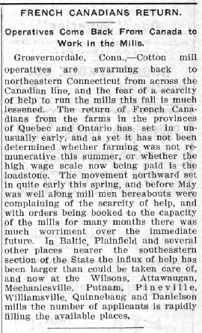
Migrant Workers Return
September 7, 1907, p 3

For instance, the return of the French-Canadian workers to their jobs in the Connecticut mills, after they spent the season tending their farms, merits special mention (right). This article fits the narrative that many of the Franco-Americans retained farms in Canada that they worked seasonally. They were migrant workers. This is by no means the only profile for the French-Canadians who came to work in the mills but it is an established narrative in the literature about them.

Further, consider this item from the August 10, 1907 edition of the trade journal:
Fall River, Mass.—Many of the mills, especially those in the eastern section of the city, are complaining of a scarcity of operatives in the ring spinning departments. Until recently these hands, who are mostly French-Canadian girls and boys, have worked pretty steadily, but now they have been attracted by the open-air life and vacations. The scarcity of small help is likely to continue through August, and is keeping the production down (p 20).
The nerve of the "small help" to prefer “the open-air life” to continuing as child labor in noisy, hot, and dangerous textile mills! What were the managers in Fall River to do without those French-speaking 8-to-10 year olds pulling their load!

This next item from the November 9, 1907 edition of the journal hints at the ethnic tensions in the mill towns as various groups vied for industrial jobs. The repatriation movement, which attempted to lure the Franco-Americans back to their Québec homeland on a permanent basis, was largely unsuccessful. But in this piece there’s evidence of repatriation without direct government involvement.
Biddeford, Me.—It is stated that the establishment of a new cotton mill at Three Rivers, Quebec, is likely to prove a serious handicap to the mill industries of this city, as a large number of French speaking loom fixers and weavers have applied for positions in the new Canadian plant. With the present scarcity of help, the manufacturers are finding it hard to find enough operatives to run the mills, and if a large number of experienced textile workers should leave it would mean an extensive curtailment of operations. The operatives are making the change because of a desire to return to their own country, where the French language is spoken, and where they will not have to compete with Greeks, as they do here (p 16).
"Situations Wanted"
The classified advertisements in the journal also demonstrate the importance of French-Canadian labor to the textile trade of the period.

In stark contrast to today’s practice, it was de rigueur for job-seekers to state their ethnicity. I examined classified ads for line positions placed through the journal's “Overseers Bureau.” I chose at random three editions at two month intervals (August 10, October 19, and December 7, 1907 issues). Out of a total of 190 ads in these three issues, about three-quarters (74%) identified their ethnicity as either “American” or “English.”  Not surprising in an English-language journal published from Boston.

Of the remaining quarter, about one-half (47%) of the advertisements were from the French-Canadian/Franco-American cohort, followed by Germans (27%), Scotch (16%), and Irish (4%), with one person claiming Belgian origins, one Polish-American, and one person who did not specify an ethnicity. Note the very small number of Irish-Americans, a total of 2 ads, both of which appear in the December 7, 1907 issue, and the complete absence of Italians from the issues I examined.

French-Canadians Seek Work
(August 24, 1907, p 21)

There are also instances in the 1907-8 journals where non-Franco-American advertisers tout their ability to speak French as well as English. Mentions of any other language are rare. French/English bilingualism was an important skill for the early 20th century “mill man.” It was as important in the textile industry in the Northeast of the time as Spanish/English bilingualism is today in many parts of USA.

Bilingualism a Plus
(August 24, 1907, p 21)
We see another advertiser who identifies himself as “English” searching for a position as overseer of spinners who describes himself as “a good manager of French help” (November 9, 1907, p 20). In a sharp reversal of the “no Irish need apply” syndrome, one Help Wanted ad for a “second hand for 200 looms running on cotton warps and worsted filling” specifies that the candidate “must be French, a good manager of help, and a hustler.” (September 14, 1907, p 18). In all likelihood someone “French” was required to work with the plethora of French-Canadian labor in this operation (location unknown).

Franco-American Labor: Fortune-Maker
We Franco-Americans in the Northeast USA tend to take a parochial view of our role in history. We focus on a family, or a community, or perhaps on a portion of a state. We do not think in sufficiently expansive terms. The truth is that we were a front-end of the wedge of American Industrialism in the post-Civil War period. 

Many Americans are well aware of the supply side of the cotton, how it was grown in the South and the labor conditions under which it was produced. We tend to think less about what happened to those bales of cotton after the harvest. The truth is that Franco-American men, women and children were the other side of the cotton in the period from about 1865-1930.

It is our ancestors’ labor, in the main, that turned that raw material into finished product, making fortunes for the Boston Brahmins who controlled this industry through the Gilded Age. This was in addition to the fortunes these families had already made in previous generations and that afforded them the capital to import a large labor force from French Canada.

As the articles above make clear, labor was in demand and the Brahmin owners fretted about losing us to Canadian mills or to our ancestral farms. They needed our forebears very much, including "the small help." The existence of a large supply of cheap labor on the borders of New England made the textile industry possible.
---------------------------
More about Franco-Americans in the mills:

Monday, December 29, 2014

Video Presentation: The Cabot Mill and Brunswick, Maine's Franco-Americans

This is a video of a presentation I delivered in April 2014 through the auspices of the Pejepscot Historical Society of Brunswick, Maine. It details the development of the Franco-American community in that town and the history of the textile mill that began to bring French-Canadians to Brunswick in the mid 19th century.

Among other topics I discuss:
  • Reasons for the exodus from rural Québec
  • Chain migration from L'Islet, QC to Brunswick
  • Conditions in the company-owned housing
  • The background of the Boston Brahmin mill owners
  • The steps the Franco-Americans took to improve their lot in adverse conditions
This talk covers some of the research I have written about before (for example here and here) but includes research and graphics that I have never before published.

I hope you have time to sit back and enjoy this presentation.


Thursday, August 2, 2012

The Case of the Cabot Mill

In the manuscript United States Census for Cumberland County, Brunswick, Maine for the year 1880, I find the family of my great-grandmother, Albina Ouellette (b. February 1868, Roxton Falls, Québec). The census reports that Albina, age twelve, her father, and seven of her eleven siblings, including her ten-year-old younger brother, worked in the Cabot Manufacturing Company textile mill. The census for Brunswick in that year contains approximately twenty continuous pages of French names. Almost all of these individuals were born in Canada and were employed by the Cabot mill. There is little doubt that the area of Brunswick represented in these pages is what is referred to in contemporary newspaper accounts as “the French Quarter” or “the French locality.”


In 1886 a serious outbreak of Diphtheria would spread through the French Quarter of Brunswick. This disease, which is associated with overcrowded and unsanitary conditions, would spread to at least 142 individuals, mostly French-speaking children, between April and September of 1886. I estimate that somewhere between eight and ten percent of the French-speaking group in the town became infected with the disease.

Mr. A.G. Tenney, editor of the English-language newspaper, the Brunswick Telegraph, mounted a campaign in his paper against the Cabot Company, which lasted several weeks and detailed the poor conditions that prevailed in the company housing in the “French locality” at that time. I will quote one passage from this series at length:

The houses are built in close contact; there are no yards; the sheds and privies are near by; the drainage – the sink spouts are running only a few feet or so outside of the houses where all dirty water is poured out – falling on the surface of the ground, some of which drains into the cellar and leaves one of the most prolific sources of disease. The houses have from two to three stories, some of which are divided into eight tenements; the average number of people is about twelve in each tenement (96 to a house); the number of rooms in each is from five to seven; bedrooms are small, many of which have only one window where there are two beds. This will give you an idea of the amount of dirty water and slops that are poured out on the surface, close by the block – leaving the most offensive odor that can exist. These large blocks are accommodated with only four privies – giving about twenty five people for each privy – and those privies are cleaned only once a year, and this is done during this present hot weather of July. These places have overflowed since the month of May.

Swine, cows, and hens are kept in the sheds, pig-pens in close connection with wood sheds &c. – giving additional offensive odor. The wells are in the midst of this filth, some of which are not more than twenty feet distant from the sink spout and privies. Sandy soil as it is in this place there is no doubt that some of these wells receive the slops in a few days after their pouring out of doors.

The collection of refuse matter in or around the dwelling houses, such as swill, waste of meat, fish and decaying vegetables, dead carcasses are all present, giving or generating disease germs, affecting the purity of the air; – they should be considered the worst kind of nuisances. Such nuisances one should be compelled to remove or dispose of either by burial, burning or otherwise. Now then, summing up in a few words the above mention will show the favorable condition for any contagious disease to spring up.
[Brunswick Telegraph, July 30, 1886]

Doctor Onesime Paré (b. June 1854, St-Gervais-de-Bellechasse, Québec) provided the Telegraph with descriptions of these conditions, as well as other information regarding the extent and spread of the disease. Doctor Paré and Mr. Tenney should be remembered for the efforts they made to draw attention to the deplorable housing conditions in the tenements. In the newspaper, the evidence of other (Yankee) doctors is brought forward to corroborate the facts as presented by Tenney.

For further corroboration, we may examine the statistics for burials at St. John’s church. William N. Locke, in his article, “The French Colony at Brunswick, Maine: A Historical Sketch” (Les Archives de Folklore, 1 (1946, pp 97-111), provides statistics on burials from this parish in the years 1877-1895. There is a sharp spike in the number of deaths among the French-Canadian community in the years 1886 and 1887. That this increase in mortality is not a natural consequence of an increase in the French-Canadian population during these years is demonstrated by the fact that there were nearly half as many burials in 1888 (41 total) as there were in 1886 (81 burials).

The sad truth is confirmed by an examination of the handwritten vital records kept by the Town of Brunswick. Here I found that 35 children died between April and September of 1886. The records, in most cases, do not state the cause of death, but, in a few, Diphtheria is cited explicitly. That the majority of these children were the victims of the Diphtheria epidemic we may surmise, apart from the newspaper’s testimony, by examining child mortality rates in the years on either side of 1886. The records reveal that nine children died between April and September 1885. In 1887, 18 children died in this same span of months.

These records also show that Diphtheria, in that summer of 1886, was not an equal opportunity disease; without exception the children who died that spring and summer had French names.

In reading the Brunswick Telegraph’s increasingly shrill outcries against the Cabot Company and its directors, I can’t help but imagine my great-grandparents and my great great grandparents, Thomas Ouellette (b. March 1836, Ste-Anne-de-la-Pocatiere, Québec) and Josephine Racine Ouellette (b. March 1842, St-Charles-de-St-Hyacinthe, Québec), or their relatives, friends, and co-workers living in such conditions. Did my great-grandmother Ouellette hear the cries of the children who had the disease? Or were the infected children too sick to cry out? Did she see the lesions caused by some forms of this disease? Did she attend the funeral of a neighbor’s child?

It’s quite likely that she did. Comparing the names of the children who died with the data provided by the 1880 census, and assuming that the cast of characters involved lived in the same places in 1886 that they did in 1880, I can confirm that children were dying all around the location where my great-grandmother lived.

The census enumerator in 1880 designated the Ouellette’s residence, in order of visitation, as dwelling 25. Two-year-old Marie Claire Ste-Marie and her eight-year-old brother, Alexis Albert, died on the same day, April 13, 1886. The census indicates that this family lived in dwelling 23“Cause of death: Diphtheria,” the town records report. Ten-month-old Joseph Desjardins died on August 26th; this family lived in dwelling 27. Nine-year-old Rosa Leblanc died on June 30th; her family resided in dwelling 29. The census also reveals that no less than thirty-one individuals lived in dwelling 29. On the assumption that these families stayed put between 1880 and 1886, I conclude that my 18-year-old great-grandmother was well aware of the dying children during these spring and summer months.

But when I recounted this history to others, even to my own family, the deflection mechanism went into full swing. The response was to try to justify the brutality our ancestors suffered.  What purpose does the deflection serve?

To answer some of these attempts at deflection, from the Telegraph’s account it is clear that Tenney had some confusion regarding the precise cause, but he was correct that overcrowded conditions are favorable to the outbreak and proliferation of the disease. The fact that the conditions in the tenements were not business as usual is attested to by numerous quotations from Tenney’s articles. For example, in the same article quoted above, Tenney describes the conditions as representing “a degree of brutality almost inconceivable in a civilized community.” Two weeks later, Tenney writes:

We only wish that the Boston Cabot gentlemen could listen to the biting denunciations of them as notorious (at least in the case under discussion) for their filthy greed, by gentlemen, we can tell them who, as manufacturers, are their equals in experience, perhaps in wealth, but infinitely their superiors in all that goes to make up the true man, regardful of the lives and health of the men and women whom they employ. Some of these manufacturers…are downright wrathy over the reflection cast upon all other manufacturers by the abominable neglect of Cabot company Directors, to remedy a state of things which no man here dares to deny exists.
[Brunswick Telegraph, August 13, 1886]
  
In the final article in the series, Tenney’s rhetoric against the Cabot Company and what he terms “the disgracefully neglected Cabot homes” reaches a crescendo leaving no doubt about how his newspaper viewed the Cabot Company and the condition of “the French operatives” of the mill:

[Its] record should consign to eternal infamy the management of this corporation, more heartless than the Fejees of old, who in hot blood, murdered their prisoners, then roasted and ate them. The Cabot Company has no such tender mercy for the poor slaves bound to it by the necessities of existence, they dying by slow poison germinated in the filth permitted by the company’s home management to flow over the soil in reeking streams from the vaults of the boarding houses, the poor people inhabiting them being powerless to secure relief.
[Brunswick Telegraph, August 20, 1886] 

From these passages it is plain that such conditions were not what was expected in those times since they were denounced as exceptionally bad even by those of the same occupation and “station in life,” as the “Boston Cabot gentlemen.” These extracts also show how at least one educated Yankee of that period regarded the French-Canadian/Franco-American mill worker of his day. The “French operatives” in the mill were, in Tenney’s view, “poor slaves” bound to the mill by “the necessities of existence”; they were “poor people…powerless to secure relief” from the disease and the conditions that contributed to it.

And the poor housing conditions had prevailed for years prior to 1886. Typhoid Fever – which is contracted through drinking water polluted by human excrement – had passed through the French Quarter in 1881 five years before the Diphtheria epidemic; it would have a return engagement in 1887. Tenney, in his 1886 series on the Cabot Mill, says that the same conditions had existed in the worker’s housing for 15 years, that is, since the early 1870s, when French-Canadians had started arriving in Brunswick in significant numbers. It was not a brief episode due, as was suggested to me, to the fact that the directors of the Cabot Company “didn’t really know what was going on.” I suspect they knew full well. Their local agents most certainly did. Their noses couldn’t lie.

The fact that French-Canadians continued to cross the border to work at the Cabot Mill, as they did during these years of the 1870s and 1880s, is more a statement about the desperate conditions in rural Québec in the late 19th century than it is proof that things “must not have been so bad.” Things were so bad. Necessity drove them into the mills anyway. Choices were few, and good choices were fewer.

For more on Franco-Americans in the textile industry please see my new book available here.

This post is excerpted and edited from my article called "French Pride and the Question of Repression" originally published in Le Forum mars-avril/March-April 2004.