Wednesday, December 12, 2012

(Another) Canadien in the American Civil War: Cyprien Racine Becomes George Root

In an earlier post I told the story of Philibert Racine alias Philip F. Root. Philibert was a Canadien veteran of the Civil War and the brother of two of my great-great-grandmothers. He served with the First Vermont Battery Light Artillery that saw action in the Red River campaign in Louisiana.

I mentioned in that post that Philibert reportedly had a brother who called himself George S. Root who served in this same unit in the Civil War. I surmised that “George” was an alias for Cyprien Racine, baptized May 30, 1843 at Saint-Damase-de-Saint-Hyacinthe, Québec. I believe that I can now confirm the theory that George S. Root was Cyprien.

In the records of the U.S. National Archives I find the following pension document recording the February 25, 1928 death of a George S. Root.

The record appears to indicate that George S. Root’s rank was Artificer, that he served in the 1st (Independent) Battery Vermont Light Artillery, and gives his place of death as Mendon, Michigan.

The place of death was significant since I had information from Racine genealogist extraordinaire, Jules Racine of Québec, that another brother of Philibert, Charles Appolinaire Racine, had contracted his second marriage in Mendon, St. Joseph County, Michigan.

I turned to the 1920 U.S. Federal Census, eight years prior to the veteran’s death, and found a George S. Root living with his wife Lucy in Mendon Township, MI. The census reports that George was born in Canada, his mother tongue was French, and that the same is true of both of his parents.

The census gives his age as 75 on January 9 or 10th of 1920, which, assuming he hadn’t yet had his birthday that year, yields a birth year of 1844. Tracing George and Lucy back through the U.S. Census of Mendon, MI, I find that George, a farmer by trade, in 1900 gives his month and year of birth as May 1844.

This is reasonably close to the May 1843 date of birth of Cyprien Racine, given that these discrepancies are often found in the census records. The information in the census seems fairly consistent with my theory that George and Cyprien are the same person.  

In 1880 I find George, Lucy and family in nearby Leonidas, MI. Here we learn that the couple had three daughters Mary, 9, Catherine, 7, and Virginia, 2. The two older girls were born in Kansas, while the youngest was born in Michigan. This places George and Lucy in Kansas from about 1871 to about 1873 but likely back in Michigan by 1878 or so.

Searching for the marriage record of George and Lucy, I find a wedding at Mendon, MI on May 27, 1869 of a George Root, born in Canada, to a Lucia Monton (also Mouton or Moutaw) born in Mendon. The age of the groom is recorded as 24, which is consistent with a birth year of 1844 or 1845.

The final document in this series is an application to the U.S. War Department for a veteran’s headstone made by Mrs. Virginia Lighthiser, most likely George S. Root’s daughter whom we met as a two-year-old in the 1880 census.

This record confirms that a George S. Root, who had close kin named Virginia, served in the Civil War in the First Vermont Battery Light Artillery, died on February 25, 1928, and is buried in Mendon, MI.

I have little doubt that my theory is correct that George S. Root is Cyprien Racine. I can now piece together the outline of his life.

Born in Québec in 1843, his family lived briefly in Richford, Vermont, on the Québec border, in the late 1840s and early 1850s before they eventually settled in Roxton Falls, QC. By 1861, Cyprien, says the Canadian census of Roxton Falls in that year, is back in the United States.

In January 1862, at the age of 18, he enlisted for service in the American Civil War and served until August 1864. He appears to have returned to Canada but, by 1869, he is married in Michigan to a woman from that state.

The family spends the earlier portion of the 1870s in Kansas before returning to St. Joseph County, Michigan. George’s is a farm family and he lives for most of his days in his wife’s hometown where he dies, at age 84, and is buried.

His brother Philibert lived in a Franco-American enclave in Brunswick, Maine, but George did not live among other Canadiens. Philibert used his Yankee alias, Philip F. Root, when it suited him and reverted to his ancestral Racine identity when that served him better.

His tombstone in St. John’s Catholic Cemetery in Brunswick reads “Philibert Racine” while the document above indicates that Cyprien's government issue headstone reads "George S. Root."

I see no evidence that Cyprien ever used his French name after coming to the States. The census says that he was a naturalized U.S. citizen and he was so not only by law, but also de facto.

Cyprien Racine, the son of a man who fought for the liberté of Québec in the Rebellion of 1837, became Grand Army of the Republic veteran and Midwestern farmer George S. Root.

Friday, December 7, 2012

"There is No Forty-Fifth Parallel": Division or Unity for French North America?

I had made a terrible faux pas. I made the mistake of asking a proud Franco-Manitoban what part of Québec he was from.

It should have been a clue that he described himself as French-Canadian rather than Québécois. But in the USA a Québécois might have used the former expression especially when speaking English. However, the author of a blog called French North America should have known better.

After correcting my misapprehension, my new Franco-Manitoban acquaintance made a revealing admission. He first said that he hated being mistaken for Québécois and then said, “There are pockets of French all over Canada. And they don’t like each other.”

Sad. But, in my experience, also true. One of the most hateful, vitriolic anti-Québec rants I have ever read appeared on the blog of an acadienne. The Acadian resentment of Québec is something I’ve noted in both written and verbal communication.

Being three-quarters a grandson of Québec and one-quarter a grandson of Acadie, I once asked a young Québécoise in the Beauce region about the Acadians. She expressed sorrow about the history of Acadie but then said that her sense was that the Acadians were the mouton noir of the Francophones in Canada.

We were not always so divided. There was a time when the French North Americans felt a unity of language, religion, and customs, at least when these were perceived as threatened.

Witness an article that appeared on page 8 of the June 9, 1911 edition of the Boston Evening Transcript. The matter at hand was a convention of Franco-Americans meeting in Biddeford, Maine to discuss the Corporation Sole controversy.
Boston Evening Transcript
June 9, 1911
French North Americans
United Against the Corporation Sole

This dispute concerned a Maine law that had placed all of the temporal property of the Catholic parishes in the state in the hands of the Bishop of Portland and his successors. The law took assets that were purchased and improved at great expense by the impecunious Franco-American Catholics and turned them into the personal property of the Bishop.

French North Americans on both sides of the border were united against the Corporation Sole legislation. The 1911 article reports that Pascal Poirier “the representative in the Canadian Senate of the French Acadian people of New Brunswick” sent the convention this message: 
“I wish to tell you that I am, like everybody else here in New Brunswick, entirely with you in heart, soul and spirit. It is the cause of the religion of our fathers, it is the French language, it is liberty, it is right you are defending…God who has made us French and Catholic – Catholic in the truest sense of the term – expects that we will defend by all means within our power, our nationality and our religion… No representation, no taxation. This motto has made of the English a nation of freemen. Let it be our motto also, especially when certain persons in authority are using our own property to destroy our children, our language, and our faith.”

Note that the “French Acadian” Senator refers to “our nationality,” which he owns as the common possession of Acadians and Franco-Americans, the majority of whom had roots in Québec. For the Senator, the Franco-Americans are a we and not a them.

I imagine that the Senator did not fancy himself any less an Acadian when he refers to “our nationality” in common with New England Franco-Americans. He had not only a local identity as Acadian but he also claims a wider French North American identity.

At the 1911 Biddeford convention a letter from Cyrille F. Delage the President of the Saint Jean Baptiste Society of Québec was also read. Monsieur Delage writes:
“We cannot attend your convention, but we are with you in heart and spirit. Your struggle interests and passionates (sic) us in the highest degree. We are following it in all the details, for it has all our sympathies, and we consider your cause our own. There is no forty-fifth parallel between the descendants of the French race in America…. Justice shall be given you and success will crown your noble efforts for the preservation of our language and our traditions. If we can aid you, either financially or otherwise please command us.”
“There is no forty-fifth parallel between the descendants of the French race in America.” Monsieur Delage seems to means the 49th parallel, the traditional border between Canada and the USA. Despite this geographical miscue, he recognizes that the French North Americans are a nation without a state straddling the border between two federal unions, the USA and the Dominion of Canada.

The word “our” is used a number of times to emphasize what M. Delage states frankly: that the struggle of the Franco-American is also the struggle of the Québécois. The great-grandparents of today’s Québec nationalists considered the Franco-Americans to be of one “race” with them.

The article also notes the enthusiastic response given by the assembly to the address, and indeed the very presence, of Olivar Asselin, a Québécois journalist, “former associate of Henri Bourassa,” “leader of the Nationalist party,” and a “special delegate from the Saint Jean Baptiste Society of Montreal,” the foremost French-Canadian national society of its day.

In addition to the journalist Asselin, the article reports that, “all the French-Canadian papers in Québec and New England, including La Presse, La Patrie, Le Devoir, and La Revue Franco-Americaine of Montreal are represented almost all of them by their editors themselves.”

When was the last time that an organ such as the venerable Le Devoir took an interest in a Franco-American convention? Imagine the editor of a major Montréal or Québec City media outlet today attending such a convention in Maine.

One hundred years ago, in a very different ideological milieu, the “French race in America” formed a coherent bloc, albeit with local distinctions. Elsewhere I have pointed to the example of the Latinos. Although they have their origins in Mexico, Cuba, Puerto Rico and other places, they have recognized their common interests and christened themselves with a new name. They have become a major socio-political bloc thereby.

The ties of language and religion that once united us across national and provincial borders have loosened considerably. But have we cooperated, unwittingly, in a strategy of divide and conquer advanced by the assimilationists? Rather than nursing grievances based on ancient resentments or parochial differences, the fragile plant I call French North America could choose to reinforce its roots in the soil of a common heritage.

Once the “French race in America” in its various pockets in Canada and the USA had a wide, continental perspective. If we may still speak of la survivance a return to this more inclusive French North American identity may be our last, best hope.

Thursday, November 29, 2012

Franco-American Labor Allied Contra The 1920s Klan

“LABOR WILL REFUSE TO ENDORSE SOVIET” screams the headline in a June 19, 1921 article in the New York Times. The paper is reporting on the forty-first annual convention of the American Federation of Labor (AFL), held at Denver, Colorado, June 13- 25 of that year.

“Radical forces,” the Times reports, “are lining up in an effort to put over a resolution calling for the recognition by the United States of the Soviet Government. The Conservative element has a resolution condemning the Trotzky (sic)/Lenin regime but expressing the friendship of American labor with the Russian people. The latter resolution…will undoubtedly be adopted.”

The New York Times reporter also notes that “a warm fight is expected over the resolution introduced by the Berlin (N.H.) Central Labor Union calling for condemnation of the Ku Klux Klan as ‘detrimental to the working people of the country and directly opposed to the Constitution of the United States of America’.”

The Proceedings of the AFL Convention record the complete text of the Berlin Central Labor Union’s resolution (pp 205-6). It is resolution number 71, introduced by delegate James A. Legassie, as follows:

There is no coincidence that this resolution was introduced by a labor organization from Berlin, New Hampshire. A perusal of the 1920 U.S. Federal Census of Berlin, the census year closest to the date of the AFL resolution, reveals a diverse, multicultural mill town.

English and Anglo-Canadian immigrants and Yankees live beside Irish, Italians and other nationalities. There are large numbers of Russians and Yiddish-speaking Russian Jews.

The largest ethnic bloc, however, is the French-Canadians. According to the official history on Berlin’s city web site, 57 percent of the population of the town was of French-Canadian origin in 1930. 

The James A. Legassie who introduced the anti-Klan resolution I believe to be the man in question in the naturalization petition below.


The Census of 1900 (Berlin Ward 2, District 0258) finds a "James Lagassé," machinist, born about 1866 who lives with his wife Emma and two sons Edward and Arthur. Both James and his wife were born in French Canada, the census claims. Everyone listed on this particular page of the census is of French-Canadian origin.

The 1920 and 1930 censuses reveals that James was from New Brunswick and claims that he spoke English before coming to the States. However, the name Legassie, in its various spellings, is a québécois name and in 1900 Legassie and family are living in a wholly Franco-American enclave. 

Legassie introduced the 1921 AFL resolution at the height of the Second Klan’s influence and appeal. The Second Klan aimed its propaganda in the North at Jews, Catholics and ‘foreigners.’ At least one of those attributes describes the vast majority of the population of Berlin in 1921.

It was multicultural Berlin's union that drew attention to the “outrageous crimes” of the Klan and were concerned enough to challenge one of the largest labor groups of the era to take an unambiguous stand against it.

And it took a delegate of French-Canadian origin, from a labor organization of a town with a French-Canadian majority, to resolve that the national Labor movement place itself contra the Invisible Empire.

Monday, November 26, 2012

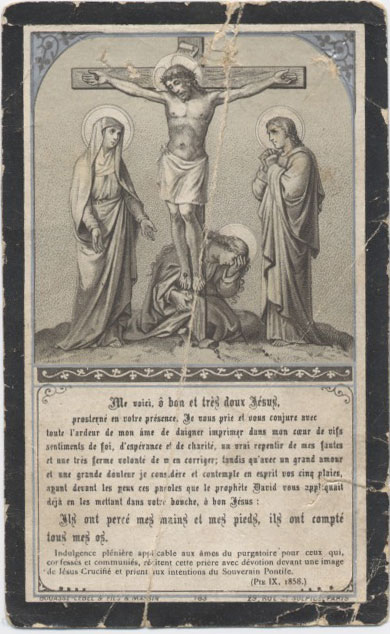
Cartes mortuaires: Funeral Cards of My Grandmother's Relatives

My grandmother showed me these funeral cards when I was a young boy. They seemed to come from another world, a context that had long-since faded away. They are a remnant of the Maine Franco-American culture as it existed in the early 20th century.

I am sure that many of my fellow Franco-Americans will nod in sympathy and familiarity with these cards, which they may have piled in a box or stuffed in a bottom drawer. 

For me these cartes mortuaires are precious relics. I can remember the reverence with which my grandmother revealed them to me, as if whispering a secret. Seeing them when I was young provided a small spark of inspiration leading me to take an interest in our family's past.

These cards represent my grandmother's maternal relatives all of whom came from what was then called the County of L'Islet, QC, the parish of Saint-Cyrille (also known as Saint-Cyrille-de-Lessard). The handwritten inscriptions on the cards are my Mémère's. She made these inscriptions in English so that her posterity would not forget her forbears.

I offer them without further comment, a moment of silence for our dearly departed.


I. Louis Bernier: uncle and godfather of Ida Lavigueur (Vermette)


II. Clarina Couchon: aunt and godmother of Ida Lavigueur

III. Arthur Bernier: grandfather of Ida Lavigueur

IV. Marie Saint-Pierre: grandmother of Ida Lavigueur

In October 2005 I visited Saint-Cyrille-de-Lessard for the first time and took the following photos. I'm not sure that any of the descendants of our line of the Berniers had returned to their ancestral parish since the times of our ancestors whose lives are commemorated above.

Here is a portion of the small parish of Saint-Cyrille seen from the hill on which sits the Church.
 

Aiming the camera just to left of the photo above, this picture shows a little of the Saint-Cyrille landscape.


Tuesday, November 13, 2012

Franklin Roosevelt’s Plan for Franco-American/French-Canadian Assimilation

The President of the United States, Franklin Delano Roosevelt, addressed a letter to Canadian Prime Minister William Lyon Mackenzie King on May 18, 1942 the bulk of which reads as follows:

When I was a boy in the ‘nineties’, I used to see a good many French Canadians who had rather recently come into the New Bedford area, near the old Delano place, at Fair Haven. They seemed very much out of place in what was still an old New England community. They segregated themselves in the mill towns and had little to do with their neighbors. I can still remember that the old generation shook their heads and used to say, ‘this is a new element which will never be assimilated. We are assimilating the Irish but these Quebec people won't even speak English. Their bodies are here, but their hearts and minds are in Quebec.’

Today, forty or fifty years later, the French-Canadian elements in Maine, New Hampshire, Massachusetts and Rhode Island are at last becoming a part of the American melting pot. They no longer vote as their churches and their societies tell them to. They are inter-marrying with the original Anglo Saxon stock; they are good, peaceful citizens, and most of them are speaking English in their homes.

At a guess, I should say that in another two generations they will be completely Americanized and will have begun to distribute their stock into the Middle West States, into the Middle states and into the Far West.

All of this leads me to wonder whether, by some sort of planning, Canada and the United States, working toward the same end, cannot do some planning -- perhaps unwritten planning which would not even be a public policy -- by which we can hasten the objective of assimilating the New England French Canadians and Canada's French Canadians into the whole of our respective bodies politic. There are of course, many methods of doing this, which depend on local circumstances. Wider opportunities can perhaps be given to them in other parts of Canada and the U.S.; and at the same time, certain opportunities can probably be given to non French Canadian stock to mingle more greatly with them in their own centers.

In other words, after nearly two hundred years with you and after seventy-five years with us, there would seem to be no good reason for great differentials between the French population elements and the rest of the racial stocks.

It is on the same basis that I am trying to work out post-war plans for the encouragement of the distribution of certain other nationalities in our large congested centers. There ought not to be such a concentration of Italians and of Jews, and even of Germans as we have today in New York City. I have started my National Resources Planning Commission to work on a survey of this kind.*

Roosevelt’s letter blithely assumes that the assimilation of the French-Canadians is a worthwhile objective. There’s not a hint of doubt that cultural homogeneity is good and this assessment applies not only to the French-Canadian element but to others as well.

However, Roosevelt also anticipates resistance to efforts to achieve this end. Why else would he stipulate that his assimilation plan might be “unwritten” and “not even…a public policy”? While his hidden assimilationist policy was in its infancy he had already taken steps to implement it, beginning with a survey.

The President also assumes that Prime Minister Mackenzie King shares his unquestioned objective of assimilating the French-Canadians. Doubtless the Prime Minister was aware of the viewpoint that the 1867 Confederation of Canada asserted a union of deux peuples fondateurs: French and English.

FDR to Canadian Prime Minister:
"We can hasten the objective of assimilating
the New England French Canadians
and Canada's French Canadians."
However one may judge the integrity with which the English-Canadians lived up to this bicultural ideal, even a tacit policy of homogenizing and anglicizing Canada in its entirety would face the resistance of Québec to say the least. Roosevelt had touched the raw nerve of Canadian nationhood. The Prime Minister appears to have sidestepped politely the quagmire into which the President dips his toe.

President Roosevelt seems to have had a measure of diffidence on this score since he avers in an introduction to his remarks that his comments might seem “amateurish” to the Prime Minister.

The crude bluntness of his statement that the French-Canadians have been “two hundred years with you” and “seventy-five years with us” is indeed amateurish since it conflates a purported peuple fondateur of a neighboring country and ally with a poor minority group in New England.

The letter fails to recognize a fundamental difference between Canada and the U.S. While Canada at least struggled with the possibility of a bicultural state, the United States adopted the melting pot theory in which all other nationalities were to be dissolved into a homogeneous solution based on Anglo-Saxon Protestant culture. 

President Roosevelt’s letter merely makes explicit, at the highest level of government, what was the tacit or overt American policy of the first half of the 20th century – and perhaps beyond. Immigrants were welcome as cheap labor for farms and factories as long as they eventually intermarried with “the original Anglo-Saxon stock,” spoke English in their homes, and exhibited no pesky linguistic or cultural “differentials.”

*A facsimile of Roosevelt’s typewritten letter appears in Jean-François Lisée, Dans l'oeil de l'aigle: Washington Face Au Québec (Montréal: Boréal, 1990) 454f.

Je remercie Mathieu Gauthier-Pilote pour l'aide bibliographique.

Saturday, November 3, 2012

Memory, Culture, and Franco-American Identity

Last month I invited Michigan native James LaForest to be a guest poster on this blog. James has now returned the favor and invited me to contribute to his. Please read my post Memory, Culture, and Franco-American Identity on James’s fine cultural and literary blog Red Cedar (formerly called Daily Returns).

After reading my post, please stick around to peruse James’s thoughtful reflections. He is a sensitive writer with a gentle touch. We’re pleased with our collaboration and hope readers of both blogs will enjoy it as well.


The Cabot Mill Complex, Brunswick, Maine, 1908

Thursday, October 18, 2012

Explorer of the Pacific Northwest: The Amazing Voyage of François-Benjamin Pillet

My third great-grandmother was a woman of mystery called Cécile Pillet. She was somehow attached to the family of the prosperous fur trader François-Benjamin Pillet. This man was a pioneer and an adventurer who participated in what must be among the greatest journeys in the annals of North America.

François-Benjamin Pillet, also known as Benjamin Pillet (Pilet, Pilette) the son of Ignace Pillet and Marie-Josepthe Lamy dit Desfond, was born on August 12, 1791 at a mission near Montréal. The place was called Lac des Deux Montagnes in French but is better known as Oka.

Oka was the First Nations settlement that in Pillet’s day included separate villages for the Algonquins and Haudenosaunee (“Iroquois”), with a small group of Canadiens many of whom were active in the fur trade.

Pillet was from a line of fur traders familiar with both the interior of the continent and the languages and ways of the native peoples. His father and his uncle, Jean-Baptiste Paschal Pillet, left a paper trail relating to their activities in the fur trade in the 18th c. They hired voyageurs and traded in the Great Lakes region as early as the 1770s.

In 1810, the wealthy American businessman John Jacob Astor hired the not quite 19-year-old François-Benjamin as a clerk for his Pacific Fur Company. Astor was well aware of the recent voyage of Lewis and Clark and smelled a business opportunity. He inquired at Montréal and enlisted a number of Canadians mainly of Scottish and French descent to establish a trading post on the Columbia River in the Pacific Northwest.

Astor sent two parties westward, one over land and one by sea. The former was to start from the Great Lakes, descend to St. Louis, and then retrace the route of Lewis and Clark to the Western sea. 

The Panama Canal still a century hence, the sea route was to sail the Atlantic to the southern tip of South America, around Cape Horn, and then northward in the Pacific to the mouth of the Columbia. Pillet was with the group that traveled by sea. His companion Gabriel Franchère preserved their adventures for posterity in a detailed journal.

The Canadians set sail from New York City in September 1810 on the Tonquin under the American flag. A skilled seaman with the dickensian name of Jonathan Thorn captained the vessel. Thorn, a veteran of the storied engagement on the shores of Tripoli, had more than a trace of Bligh in him. He took an instant dislike to the land-lubbing traders.

His animus became dangerous when the Tonquin reached the Falkland Islands in search of fresh water. Pillet, Franchère and some others took to exploring the strange island of penguins and missed the signal to return to the ship. Thorn weighed anchor and shipped off marooning the party on the islands.

Perceiving their predicament, Pillet and company rowed hard for three and a half hours so as not to lose sight of the ship. At last Thorn relented and they were taken back on board. Thorn’s mood may have been altered by one of the Scotsmen, a relative of one of the men he had attempted to maroon, who drew his pistol and threatened to blow the captain’s brains out.

Rounding the Horn, the Tonquin's next port of call was the Hawaiian Islands. Pillet and Franchère spent a night on land exploring and observing Hawaiian customs. At Hawaii, a couple of the crew members remained, while the Tonquin engaged a number of islanders, famously skilled boatmen.

This mixed party of Scots, French-Canadians, Americans, and Hawaiians finally reached the Columbia in March of 1811. They quickly established a trading post they called Astoria. The party traveling over land having been divided and with some loss of life reached Astoria in January and February of 1812.

From Franchère’s account, Pillet emerges as singularly curious and intrepid. When one of the Hawaiians is killed in an accident it is Pillet and Franchère who accompany his countrymen to the burial of their comrade and observe their rites. Pillet makes several side trips to the interior, to the region near Spokane and another in the Willamette River area.

He is a skilled hunter and fisherman and appears to know French and English as well as more than one Native language. In one encounter with the natives, when several attempts at communication in other tongues fail, Pillet comes forward to try the Cree language which his interlocutors understand in part.

One of the Astorians named Ross Cox who also wrote an account of these travels relates that during his Spokane adventure Pillet fought a duel with Nicolas Montour of the rival Northwest Company, “with pocket pistols, at six paces; both hits; one in the collar of the coat, and the other in the leg of the trousers. Two of their men acted as seconds and the tailor speedily healed their wounds.”

In January 1813 news reached Astoria that Great Britain and the United States were at war. This placed the Canadians, British subjects trading under the American flag, in an awkward position.

In September the Astorians learned that a British warship had been sent to seize the American post at Astoria. Representatives of the Northwest Company, Canadians under the British flag, made an offer to buy out the Pacific Fur Company. The offer was accepted in October 1813. The British Union Jack was hoisted and Astoria was renamed Fort George.

A number of the former Astorians signed on with the Northwesters. Pillet and Franchère were two among a party of ninety that chose to return to Montréal. The Tonquin having been destroyed, and its captain and crew massacred in a battle with the natives provoked by Thorn’s arrogance, the party had little choice but to set out by land. A flotilla of 10 canoes, with men, goods, and provisions headed eastward on April 4, 1814.

They traveled mostly along the waterways beginning with an ascent of the Columbia. With great difficulty they survived the mountains and, by the first of June, found their way to the mouth of the Pembina River, west of present-day Edmonton, Alberta.

By the tenth they had reached Fort Vermillion near the modern day border of Alberta and Saskatchewan. They arrived at Lake Winnipeg by the end of the month, achieving Fort William at Lake Superior (now part of Thunder Bay, Ontario) on July 14th.

Here the party appears to have divided, with Franchère traveling sans Pillet with an advance guard. The route from the Great Lakes, to the Ottawa River, to the St. Lawrence was well known to the Canadiens. Franchère’s journey ended at Montréal on September 1, 1814. 

We know that Pillet was home no later than April 1815 since he is a witness at a marriage in Les Cedres, not far from Oka, in that month. When he returned home he must have learned of the death of his father in 1811. 

Pillet married his first cousin Julie Pillet, the daughter of Paschal Pillet and Marguerite LaCroix, on January 16, 1817 at Oka. His eldest son François d'Assise-Benjamin, also known as Antoine, was born there on September 21st of that same year. Around 1820, Pillet and family relocated to the parish of Sainte-Geneviève-de-Pierrefonds on the island of Montréal. 

Pillet appears to have been a prosperous merchant. The notary records reveal his many business dealings and transactions. The will of his mother, who died in 1826, was litigated leaving a detailed account of the impressive Pillet holdings. His son Antoine received an education at Montréal. He studied medicine and practiced this profession among the people of Oka.
1879 Map of Ste-Geneviève
The Pillet ("Pilette") property is
along the river northeast of the church
Source: BAnQ

François-Benjamin supported the Patriotes in the Québec Rebellion of 1837. His son was deposed regarding an incident in this war. Pillet’s nephew, Rodolphe Des Rivières, was among the leaders of the rebellion and fought at the Battle of St-Charles-sur-Richelieu.

François-Benjamin Pillet, astorian, died on January 31, 1858. He was buried the following day at Ste-Geneviève. 

In the 1911 Canadian Census I find his descendants still living at this parish a century after Pillet’s Pacific adventures. They may be there still.

[See this post for more about French-Canadians in the Pacific Northwest.]